The first software iteration was developed in 2012 by Matt Taylor, WSP Design Automation Lead. It has been continually improved over time, drawing on data from colleagues across the UK, New Zealand, Australia and beyond, and applying learnings from testing it on projects across the globe.
Neil Ganju, Digital Engineering Director – Bridges Aviation and Roads says:
“Our teams in Australia use Carb0nise because it is incredibly fast to generate an embodied carbon estimate from a Revit model and enables users to explore alternative materials. Importantly, it also allows users to estimate steel reinforcement for reinforced concrete structures—even if the steel reinforcement hasn't been modelled in Revit.
“The Australian construction industry has been at the forefront of using building information modelling (BIM) to deliver complex, major transport infrastructure projects. WSP has developed advanced capabilities in BIM, and Revit is now used for the majority of our structural designs.”
Leveraging this expertise, WSP teams in Australia have implemented Carb0nise to retroactively measure the embodied carbon of past projects. This creates a valuable database that can serve as benchmarks for our design teams from the very beginning of new projects, enabling them to understand the embodied carbon implications of their designs. With Carb0nise now configured for Australian projects, WSP will seamlessly integrate it into project delivery, allowing for semi-automated measurement and tracking of embodied carbon in our designs.
Carb0nise enables users to compare a reduced carbon design with a 'regular' historical design. Two options are shown for each material: a carbon-reducing option, and a traditional material option. These values allow the designer to estimate reductions and make real-time choices. Allowances are added for components that are not modelled, such as reinforcement, insulation, and connections.
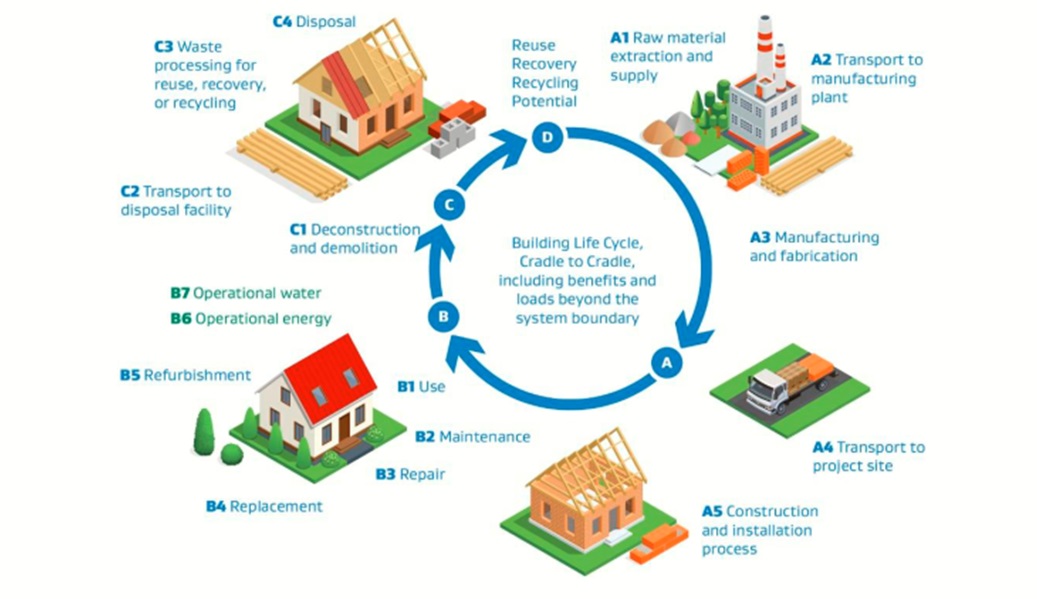
Currently, the tool can be used to assess stages A, C, and D of the below diagram:
Alternative design solutions are possible within the same model, and each can include different design options, phases and elements. The options are visualised, totalled, and exported separately, allowing easy comparison. The program output can be shown in tools such as Power BI to create easy to read dashboards and used as a baseline for future products.
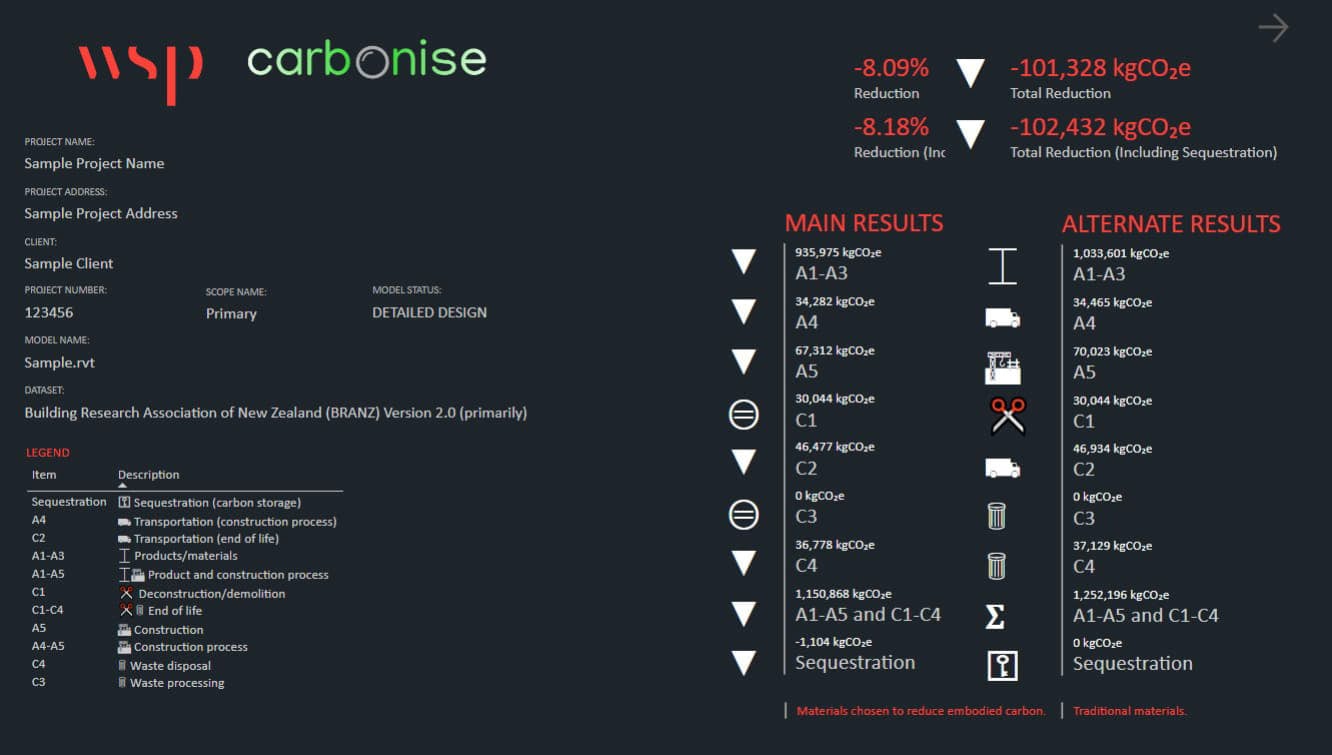 Example project results-comparison report using Carb0nise
Carb0nise is useful for live projects, for benchmarking past projects and benchmarking construction methods and for early concept guidance. It enables clients to have input into material choices that affect embodied carbon emissions, and through benchmarking our projects, it is helping WSP and our clients to deliver more sustainable projects.
Contact us below to discuss how Carb0nise, and other digital tools could help to address your decarbonisation challenges.