What first sparked your interest in mining and what has kept you passionate about it?
I live in Western Australia, a region considered to be one of the global mining hubs. Being around that environment and seeing the opportunities that come from having a career in mining really caught my interest.
There was also the challenge of the work, as most of our mining projects are delivered in remote locations across Australia. As a younger person, I was excited by the idea of traveling around the country.
It was a rewarding career to get into and get ahead in, as well.
What technical challenge has had the biggest impact on your career and how did you approach it?
One of the biggest challenges has been bringing together large, multidisciplinary teams across remote locations and ensuring everyone is aligned on a shared outcome. Many people don't realise that some of the world's largest mineral deposits are located in extremely remote environments, with project sites that can span hundreds of kilometres.
Successfully delivering projects at that scale requires strong coordination, clear communication and a relentless focus on bringing people together to achieve a common goal.
What are mining’s biggest challenges? How is WSP helping to address these challenges – globally and locally?
The biggest challenges are certainty around project delivery and the time it takes to get a project from inception to completion. Clients need confidence around schedule, capital cost and whether a project can successfully navigate permitting and development.
At WSP, a big part of our role is helping clients improve confidence in project planning and decision making. We work with them to evaluate options, define scope, understand capital requirements and identify the most viable path forward. We also help navigate permitting requirements and manage risks throughout the project lifecycle.
Ultimately, it comes down to discipline and making informed decisions early. The regions and projects that do that well are the ones that will continue to attract investment from major mining companies.
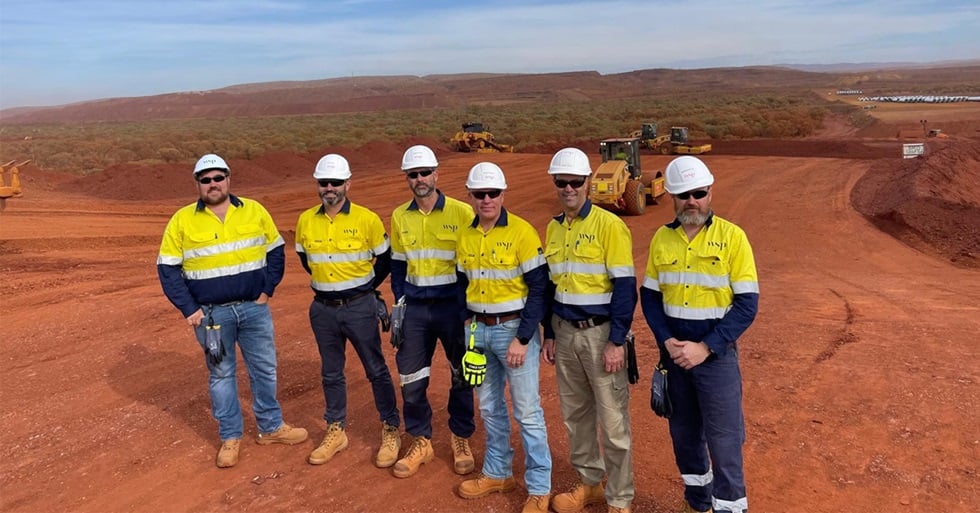
Adrian Chapman, pictured wearing yellow gloves, with members of the WSP team at a mining site in Australia.
How is the mining industry changing – including technology, client expectations and future trends? How can mining better translate innovation into operational performance?
Right now, there’s a shift towards using data to drive decision making. So big data, as well as automation. We're seeing a lot of automation across operations. Plus, the drive for decarbonisation.
The fuel situation at the moment is really accelerating the energy transition for mining fleets and rail fleets to switch to battery electric, as an example.
As for automation, it’s helping create a more efficient mine site. That doesn’t necessarily mean a reduced workforce. Instead, it’s driving efficiency and more importantly, can lead to a safer mine site.
Some automation systems can help reduce the risk involved in haulage and people’s exposure to activities that have the potential to cause serious harm. That's the upshot of automation, reducing risk for people.
And while we can talk about technology and client expectations, one of the biggest things that we're also seeing is the diversity, the way that the mining industry has become a more inclusive environment. We’re seeing the industry emphasise opportunities for local traditional owner groups and strive for a more diverse workforce.
Will future copper supplies become harder to deliver?
They will. I mean, grades are getting lower, mines are getting deeper and more complex in the copper environment. The inputs involved with that — energy, water — are going to make it more challenging to bring copper into the supply chain.
What excites you most about the future of mining and metals? What will define a successful mine in 2040?
I think an exciting part about successful mines in 2040 is how the digital capability that we've got now will help drive efficiencies for miners.
Digital solutions will allow operations to run at greater efficiency and help support safer operations. That’s especially important with the way costs are continuing to grow.
Those mines will be using digital to help with decision making or automation alongside the mine operators. As I said, it's not replacing, it's just helping to drive smarter choices. I believe that a successful mine in 2040 will have wholly embraced automation and all the data that goes along with that digital delivery.
Looking back, what career moment had the biggest impact?
What immediately springs to mind is the first time I set foot on a mine site. I just took in the mine’s sheer size, its scale and remoteness.
When it comes to a career moment, the one that had the biggest impact for me was being involved in developing the Roy Hill Iron Ore Mine and infrastructure in the Pilbara region of Western Australia. That's a 60 million ton per annum iron ore operation, one of the largest mining developments in Australia.
Helping to deliver 344 kilometres worth of heavy haul rail in one of the harshest environments you could come across left a big impact on me. Just seeing it come to fruition, from zero to trains running and iron ore being brought out of that mine, really brought home the scale of what we’d achieved. That's probably the biggest one.