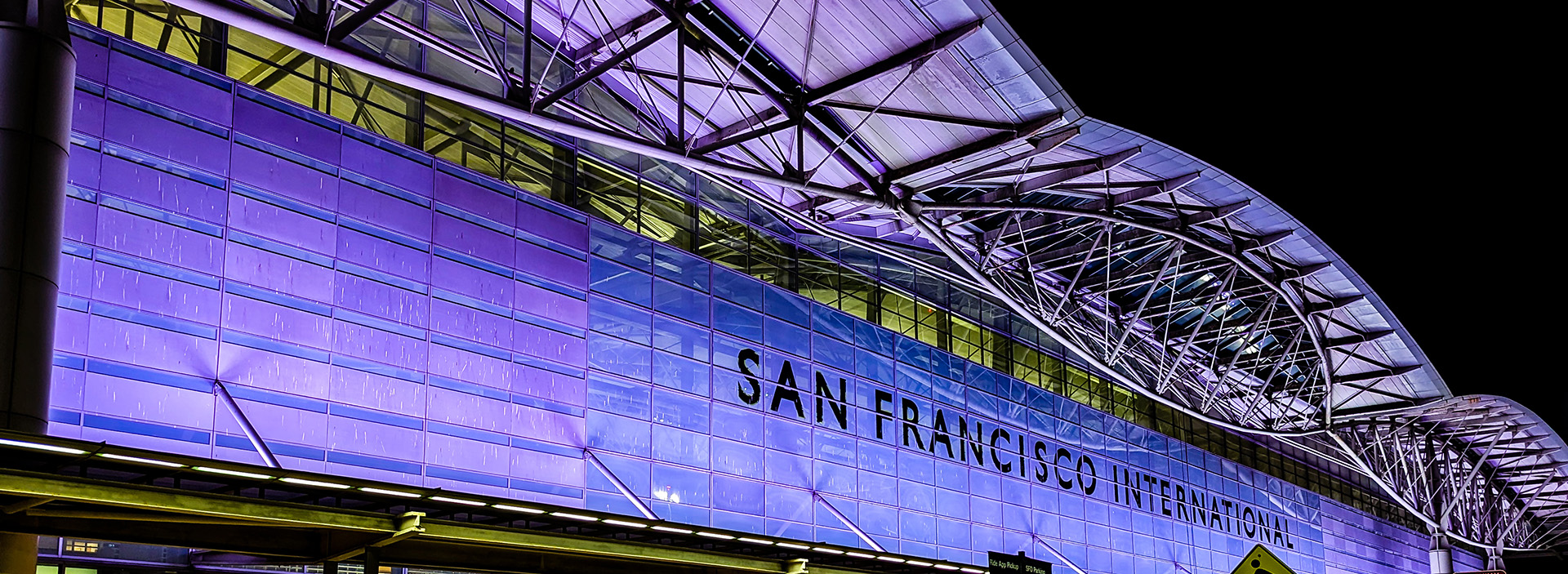
Around 50 million guests travel through San Francisco International Airport (SFO) each year. But in 2020, that number dropped to fewer than 20 million people. Undaunted, SFO used the reduced facility use brought on by COVID-19 as motivation to double down on part of its strategic vision — namely, become the first zero net energy airport in the country.
Knowledge is power
To reach this bold target, SFO needed to take a vital first step: understanding energy use across its 14.5-million-square-foot campus. With over 90 buildings using numerous operating systems of varying ages, at least 29 standalone building management systems and many gas, thermal, water and electric meters, gaining understanding was no easy feat.
The solution? An Energy Management Control System (EMCS) to enable data collection and analytics to validate, track and support energy savings goals on the path to net zero.
The EMCS is made up of two complementary platforms: an Enterprise Building Management System, which implements maintenance and control strategies, and an Enterprise Analytics Engine that actively monitors key performance indicators and tracks equipment malfunctions.
The EMCS brings together the airport’s different building management systems onto a single platform, allowing operators to see and control them through a common interface. A dedicated analytics platform aggregating the airport’s gas, thermal, water and electric meters provides a detailed picture of consumption behavior across the campus, offering access to information such as which tenants consume the most energy, the impact of different aircraft types on energy usage at the airport, how the movement of people and weather patterns can be used to predict energy consumption and where most electricity or water gets used.
Simple yet sophisticated
Achieving this elegant, single-platform solution took know-how.
Not only did SFO need a system that could gather and analyze building data from across the complex site, but they also needed the system to be able to interact with additional data repositories such as databases managing airport business, flight information display systems and transport network company data.
Here, there were 29 building systems in use that had to migrate onto a converged Internet Protocol (IP) campus network and exchange data into the new centralized platform. One key challenge was making sure that any data feeding into the platform would be usable, something complicated by the fact the airport’s systems did not use the same naming conventions or data granularity. An important part of our role was to create a common tagging standard in the platform, which allows airport staff to extract valuable data from all equipment.
Our team created a roadmap for SFO to implement the EMCS that considered the current state of their building systems as well as the end goal. This roadmap aligned with SFO’s planned programs and project budget and enabled the drive toward their sustainability goals. The roadmap broke down necessary steps, like assessing and upgrading existing infrastructure, integrating electricity, water, gas and thermal meters and designing the appropriate sequence of operations, fault diagnostic limits and cybersecurity specifications.