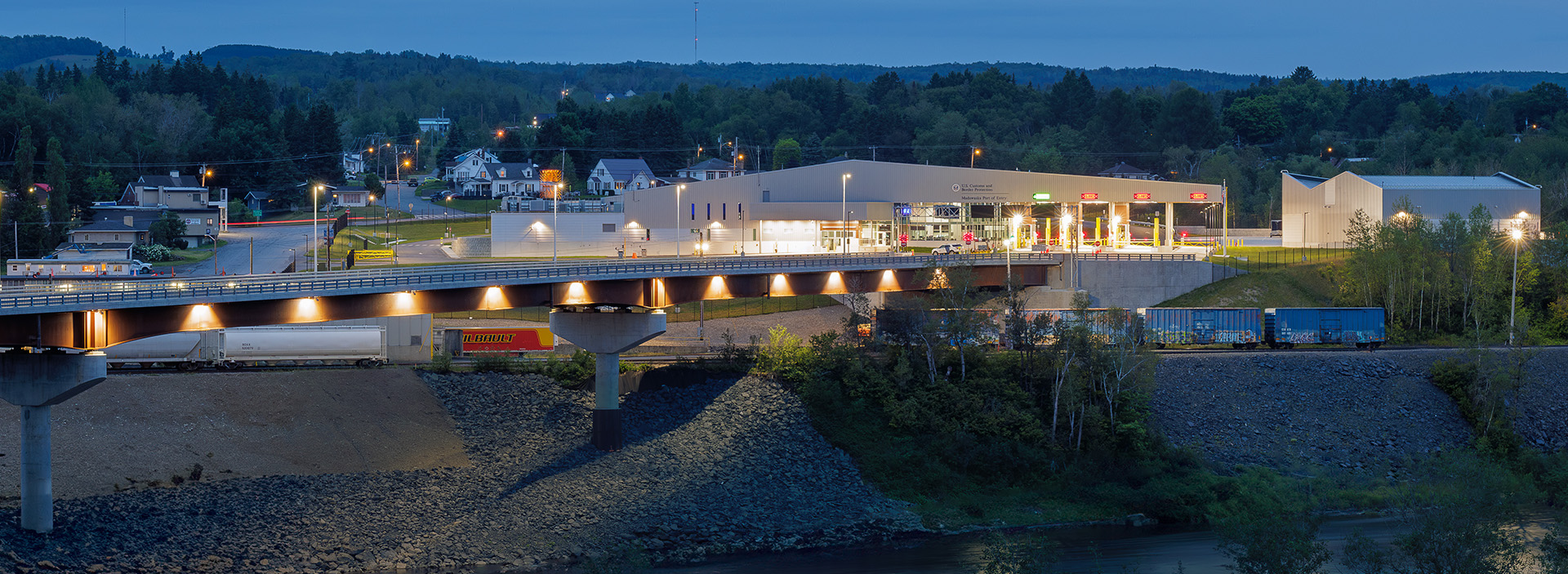
The new U.S. Madawaska Land Port of Entry (LPOE) is situated on a bluff in Madawaska, Maine, one of the four corners of the country and the northernmost town in New England. It’s an international border crossing that serves everything from commercial trucks to people on snowmobiles.
The previous facility connected the town with New Brunswick, Canada, via the International Bridge over the St. John River. With the bridge nearing the end of its useful life, both a new bridge and a new LPOE building were needed for the 10.7-acre site.
Improved flow and function drove design, and the team was tasked with balancing a welcoming site experience with security requirements, all while respecting the boreal forest terrestrial biome.
WSP knew just how to achieve this goal: design to SITES certification, a holistic approach to regenerative landscapes.
SITES on Sustainability
SITES, administered by Green Business Certification Inc., offers performance measures in addition to prescribed solutions for sustainability. The tiered certification system encourages the design of resilient outdoor spaces, with a points scale to measure improvements, from reduced water demand and stormwater runoff, enhanced biodiversity, protection of critical habitat, reduced energy consumption, improved air quality and more.
Paired with Leadership in Energy and Environmental Design (LEED), buildings and surrounding landscapes are designed in harmony, with sustainability and resilience underlining every decision. The LPOE project is pursuing both a SITES Silver and a LEED Gold rating.
For this facility, the client chose a previously developed site that was no longer in use, which allowed the team to remediate underground tanks, revegetate with native plantings, preserve undeveloped land and bring additional uplift to the surrounding environment and community.
And there are SITES points to support that choice.
To make the project truly restorative, the design utilized several SITES resilience features to increase sustainability and achieve the desired certification levels. Roofing and pavement materials were selected to reduce urban heat island effects. Lighting fixtures were chosen based on Backlight-Uplight-Glare ratings to minimize impact on the circadian rhythms of surrounding wildlife while ensuring visibility for occupants.
A surface stormwater basin was designed to retain runoff from the 95th percentile design storm, with infiltration to collect and treat stormwater runoff from at least 95 percent of the impervious area of the project. Hearty indigenous vegetation was restored to the site, eliminating the need for irrigation, while improving site stabilization.