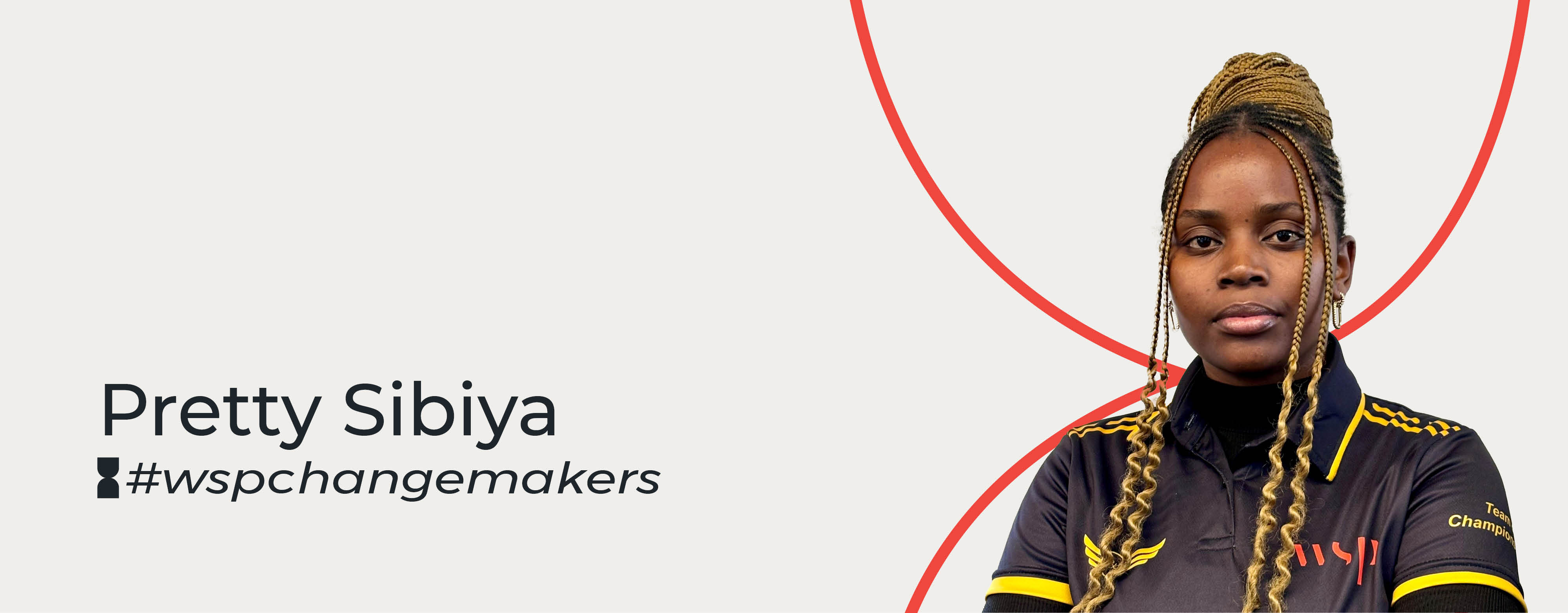
“I was born to a very large family, as my grandfather had three wives, and each had seven children. However, in neither my family nor the village where I grew up was there much education or modelling to encourage me to pursue the dream of graduating as an engineer,” she relates.
Pretty's schooling also lacked the resources and exposure to engineering. “It was very hard to find information in order to decide what career I wanted to pursue, because within our community there weren't a lot of options. Women were expected to either become a nurse or a teacher, with those two possibilities being presented as the most popular roads to success,” she relates.
However, Pretty leaned towards mathematics and science rather than healing or education. She found a guiding light in her teachers, with one particular teacher in high school encouraging her to focus on her abilities and what she would like to do with her life.
Another source of inspiration that led Pretty to civil engineering was her father, who despite lacking a formal engineering education, formed his own construction business.
“It was challenging growing up to see what the future could hold. I think I only realised what engineering is all about and opened to a number of opportunities when I started university and pursued my Bachelor of Science in Engineering degree in KwaZulu Natal,” she relates.
University was not easy, particularly as Pretty lacked some of the foundational steps that her peers had access to earlier in their education. However, a yearlong bridging course enabled her to adjust, and her five years at university proved to be pivotal to her career path.
“Our lecturers motivated us to apply for bursaries and stressed that there were companies that were keen to support and grow potential engineers. They also made me aware that not all companies were solely interested in all-A students but were looking for potential talent. Reaching out is what led me to WSP and resulted in me starting my career path here in my final year of studies,” she explains.
As that was in 2021, Pretty's entry into civil engineering coincided with the height of the global pandemic, which delayed her vocational work a little. A year later, however, she found herself being introduced to on-the-job training, mentoring and on-site work.
The limitations of the pandemic also prepared her further for a permanent position with WSP, since the heavy use of online tools helped Pretty get to grips with working within the digital environment, and WSP uses digitalisation extensively to be innovative as a company.
“I then undertook the internship program, where they taught us how to design and I was assigned to the Geometrics, Transport and Infrastructure team. There, I had mentors who really showed me what engineering entails on a practical level,” she explains.
Her internship culminated in being offered a full-time position with the company as a graduate engineer in 2023, which also opened up opportunities for Pretty to represent WSP in industry involvement with Consulting Engineers South Africa Youth Professional Forum (CESA YPF), as well as to participate in WSP's Corporate Social Responsibility (CSR) outreach initiatives.
“All that I have been through has impacted how I view the world and stoked a desire within me to give back to communities, as that is close to my heart. I believe engineering is ultimately a form of service, and about making life easier for people and a viable way of adding value to society,” she continues.
Amid her CSR projects, which included a leadership talk, Nelson Mandela donation drive, and speed mentoring initiative, Pretty has also been involved in notable civil engineering projects. One such project involved designing and building roads at a mine site in Guinea.
“That was a prime example of how civil engineering can improve the lives of people. It was in an undeveloped, mountainous area, and I was fortunate to be part of such a groundbreaking project that will not only benefit the mine but the villagers too,” she enthuses.
Currently, Pretty has a packed workday. Along with working across time zones on international projects, doing civil engineering designs and coordinating with other teams to ensure alignment across multiple disciplines, she is also enrolled in a year-long business and consulting engineering program that teaches business management.
“This is to enable me to understand how businesses operate and how to better improve our efficiencies to have the most impact on our business, our clients’ businesses and projects and the communities where we operate,” she elaborates.
When not working Pretty spends time with family and is involved in activities at church, mainly singing, and enjoys hiking. Having accomplished so much already, Pretty still has dreams and goals for the future. One of these is seeing the profession elevated and more engineers being community orientated.
“I believe that at the core of engineering is serving people's needs. I’d like to see more engineers becoming involved with communities, to drive engagement and knowledge sharing to improve people’s understanding of what engineers do and how engineering helps improve people's lives,” she concludes.