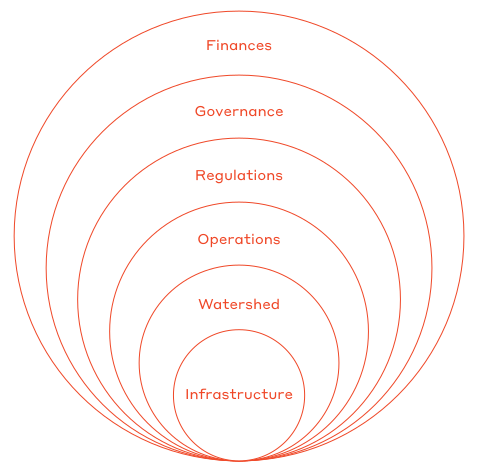
Let’s consider a typical city. Every day, water flows from a water source, through a treatment system producing clean drinking water, then through pipes hidden underground to deliver water into homes. Of course, this water must also have a way out -- a system of wastewater pipes, also hidden, that removes used water from homes, delivering it to a treatment system, and back to the environment – usually a river, lake or ocean. There is yet another system to consider when it comes to water removal. The way cities have been built has made the surface impervious, so rain no longer seeps into the ground. Therefore, there is a third system, still mostly hidden, that removes the stormwater from our cities to prevent flooding, and sends it to the nearest water body.
Risks to our water systems should be looked at using a One Water approach: from source to tap and sink to watershed
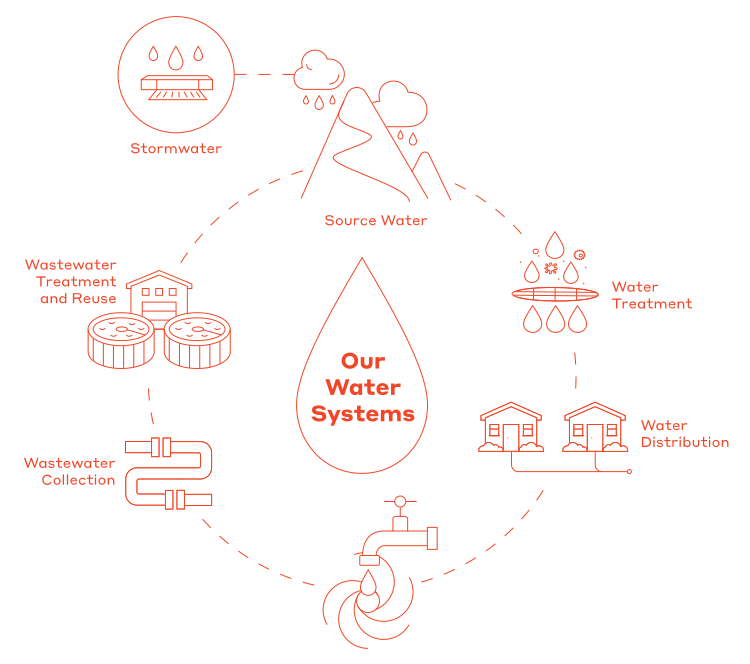
Water Systems and the Case for a One Water Approach
Our water systems are critical pieces of our ecosystems and community infrastructure which not only provides a life sustaining role, also carries multiple values and benefits. This includes water’s role in the social and cultural sphere supporting mental health, recreation and spiritual well-being, its role in our natural environment sustaining biodiversity and ecosystems, and economic role sustaining industry, agriculture, tourism and energy supply.
In the early 20th century, life expectancy in the US jumped from 47 to 63 years. By some estimates, the treatment of drinking water was responsible for about half this increase in life expectancy among city dwellers. Impressively, the development of water treatment technology was named the #4 most important engineering achievement of the 20th century, just behind air travel, automobiles and electrification, but ahead of the internet. According to the latest Global Risks Report, published annually by the World Economic Forum, following the 2008-2009 financial crisis, the top global risks identified by respondents were income disparity and asset price collapses. However, for the past several years this opinion has shifted, with respondents identifying extreme weather events, climate action failure, biodiversity loss and ecosystem collapse, natural disasters and water crises as the top five global risks. It’s difficult to overstate how fundamental these interconnected systems are to the urban lifestyle.
Canada has been seeing a rise in extreme weather events such as flooding, extreme heat, drought and fires, which have exceeded $1 billion in damages annually since 2009 and preliminary estimates for 2023 alone at $3.5 billion. There is a significant infrastructure deficit estimated at $3.8 billion for BC's water and wastewater infrastructure alone, and studies have found that Canadians’ trust in our water systems is low. These trends are making it increasingly challenging to maintain and finance operations, meet regulations, and maintain the service levels expected by the public that protect public and environmental health.
A more integrated approach between the professionals involved in the management of our water and wastewater systems will be required to address these challenges over the long-term, to identify the most important risks to the health and safety of our water systems and focus efforts where most needed. The approach to water management has traditionally been segmented into either drinking water, wastewater or stormwater, but we know, intuitively, that the hydrologic cycle is interconnected. One Water is a new approach to cooperatively and holistically manage our water systems by connecting the siloed components.