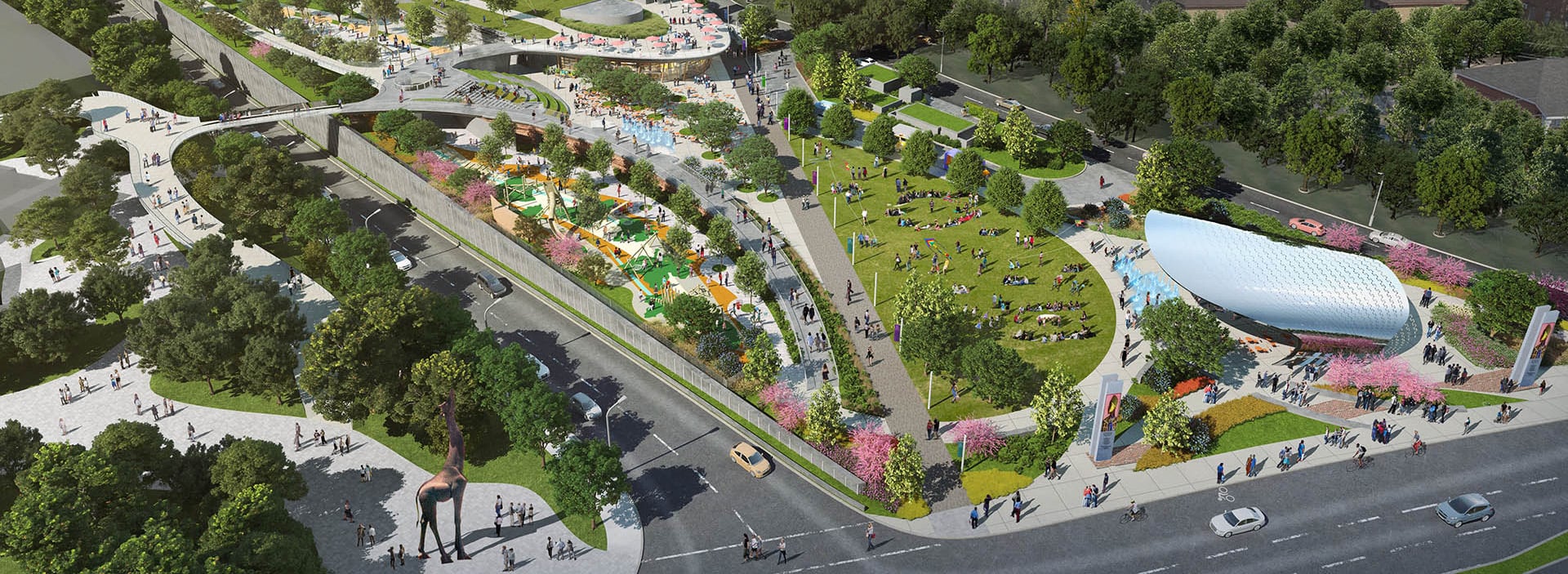
Across the country, deck lids are helping mend fractures created by mid‑century highway construction, creating valuable urban space where none previously existed.
Denver’s Central 70 project is a recent prominent example. As part of the 10‑mile corridor reconstruction, a four‑acre park was built atop a section of Interstate 70, reconnecting the Elyria and Swansea neighborhoods.
As the project’s lead engineering firm, WSP helped create an active public space featuring playgrounds, soccer fields, gathering areas and ADA‑accessible crossings. Completed in 2023, the cap turned a long‑standing physical barrier into a unified corridor that strengthens community cohesion.
The Over-Under: Lady Bird Lake
Not every site requires capping a highway from above. Sometimes community development is better served under the highway, such as with the Lady Bird Lake component of the I‑35 Capital Express Central project in Austin.
This initiative focuses on transforming the area beneath and around the highway bridge crossing into a safer, more attractive and better-connected public space. WSP designed improvements to the Ann and Roy Butler Hike-and-Bike Trail, enhancing its continuity where it passes under the interstate and linking it seamlessly to new pedestrian bridges.
Project upgrades include the north shore environment with aesthetic lighting, picnic areas, shoreline stabilization, public-art-ready walls and improved water access, while also making room for future kayak docks. There are also two new pedestrian-only bridges with shade structures inspired by Austin’s bat colonies.
Together, these enhancements revitalize what was previously a utilitarian, parking-lot-like area, turning it into an activated waterfront space that supports recreation, mobility and community life.
“Lady Bird Lake shows that when capping isn’t feasible, highways can still be softened, activated and humanized from below,” said Arash Saeedi, PE, vice president and local Transportation business leader at WSP in the U.S. “The impact these upgrades will have on the quality of life for Austin motorists and residents alike will be profound.”