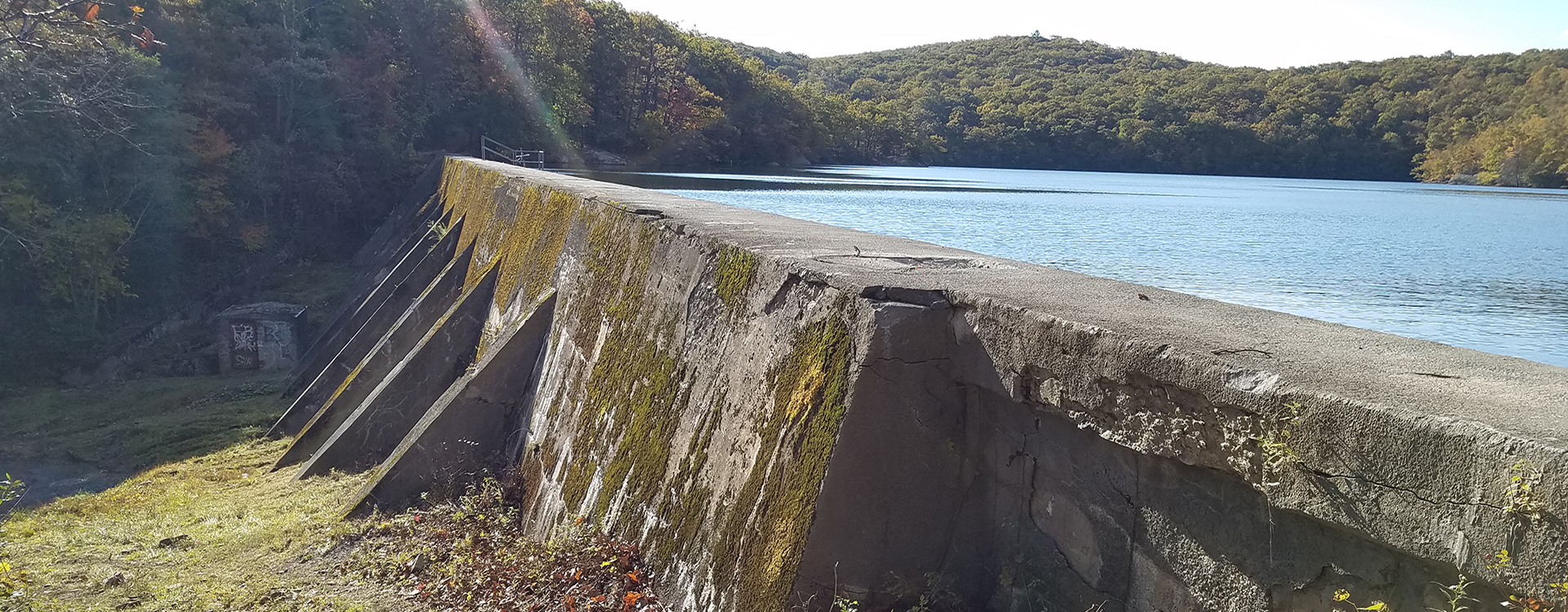
The Mount Beacon dam, a Class C “high-hazard” structure, impounds the 124-million gallon Beacon Reservoir and is used for water supply for the City of Beacon. The high hazard designation by the New York State Department of Environmental Conservation indicates its location and the potentially destructive impacts of a catastrophic failure, which could send millions of gallons of water rushing toward the city.
The northwest-southeast oriented structures include a 240-foot-long concrete left non-overflow section, a 44-foot-long spillway section, a 32-foot-long right non-overflow section, a low-level water supply intake structure, and an upstream sluice gate and associated downstream gate valve. Downstream of the dam is a vegetated channel that passes through a culvert, continuing into Dry Brook.
WSP performed a safety inspection of the dam, which used a visual inspection checklist and photographs to record observed conditions. The investigation concluded that the dam did not exhibit any obvious signs of instability that required immediate action.
However, recommendations were provided to assist the City of Beacon to maintain the dam and its appurtenant structures in safe operating condition. These recommendations have been included in the rehabilitation design, which WSP is developing based on updated and refined hydrologic and hydraulic and stability analyses. Those analysis calculations raise the dam crest by two feet. Sliding and overturning stability analyses were performed to evaluate the stability of the dam for the following loading conditions: normal loading; normal loading + ice; flood loading during spillway design flood; and seismic loading.
The project will expand the capacity of the dam’s spillway, which will be designed to handle rainfall from a “once-in-a-lifetime” storm.