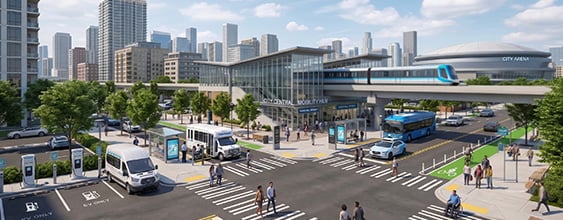
Retrofitting could rejuvenate abandoned urban cores, and be a catalyst for more sustainable urban planning, says Martin Sing.
Retrofitting is an opportunity for reinvention
Repurposing our existing building stock is going to be essential to addressing the climate crisis. Historically, humans have had a use-dispose mentality, and that has been fed by the fact that financial economics was the primary driver: we’ve long believed that it’s less expensive to tear down an old building and replace it than to retrofit. Now we’re entering an era where carbon needs to be part of that equation too. From a carbon perspective, we can’t afford to simply demolish existing assets, so we need to figure out a mechanism for valuing the carbon they contain and incorporating that into our decision-making. That challenge also comes with an opportunity: to reinvent our cities and our societies and bring central business districts back to life.
If we embrace a hybrid working environment, it’s an opportunity to reduce that duplication of living and working space.
Martin Sing
National Market Leader - Energy and Sustainability, Canada
Martin Sing
National Market Leader - Energy and Sustainability, Canada
Office-to-residential conversions could rejuvenate central business districts
Covid has highlighted an issue with the way we’ve planned our cities, particularly in North America. We’ve always kept business areas separate from residential areas, with the result that they have suffered with the increase in hybrid working. People aren’t visiting our urban cores as frequently, and many shops and restaurants have had to either scale back or close. But, from a carbon perspective, forcing people back to the workplace isn’t necessarily the right choice, because it means we continue to propagate a built environment for part-time use. If we all commute to an office, for eight hours a day our homes are sitting there unoccupied, consuming energy. Instead, if we embrace a hybrid working environment, it’s an opportunity to reduce that duplication of living and working space, so we need less overall. By taking those surplus office buildings and retrofitting them for a mix of uses, including homes, we can diversify our urban cores and revive their economies
Diversifying city centres could cut infrastructure emissions too
Embracing hybrid working and mixed-use urban cores also reduces demand for transportation, either because people live closer to where they work, or because they commute less frequently. With fewer, shorter journeys, alternative transport becomes more practical, vehicle emissions are lower, and we don’t need to invest as much embodied carbon into new or expanded infrastructure.
Using our built environment more efficiently also reduces the amount of energy and water we need. This can extend the lifespan of existing infrastructure assets and reduce the amount of new infrastructure that growing communities need. It also brings the goal of decarbonizing our buildings and transport networks closer, because we don’t have to generate as much renewable electricity to power them.
Sustainable urban planning (re)locates functions where they will use the least energy …
Electrification is driving demand for clean, renewable electricity, but without more investment, there are limitations on our capacity to generate and distribute the power needed. We will need to carry out major retrofitting programmes to not only electrify our buildings but improve their thermal performance to minimize demand – in Canada, we have roughly 480,000 commercial and public buildings that must be decarbonized, and we can’t simply tear them all down and start anew.
This is an opportunity to step back and consider how those buildings are used, and whether converting them to different functions would result in a lower carbon impact and avoid the high embodied carbon cost to build new. The location of a building also has a range of implications in terms of how people travel there, or how supplies or materials are transported, which are just starting to become part of the discussion.
… or where their surplus energy could be used by someone else
Achieving net zero needs to be a holistic, concerted, collaborative effort. We rely on governments to lead and bring about change, but multiple stakeholders across society have a big part to play in bringing different sectors together to find better solutions. One example is the location of data centres, on which our automated, digitized world is becoming ever more reliant. These facilities reject enormous amounts of heat to stay operational, and while more efficient technologies are being developed, there is no magic bullet that will stop them being exothermic, especially with the exponential growth of AI.
Part of the solution is to recognize that one sector’s waste energy is somebody else’s resource and figure out how to link them. Today, every home in Canada has a heating system, and most are powered by fossil fuels. What if we introduced a planning criterion that the waste heat from data centres must be redirected into a district heating system? That would save huge amounts of energy and offset the emissions from buildings that no longer need to generate heat. Retrofitting our cities could be a catalyst for leveraging these symbiotic situations and taking a more holistic approach to the way we plan.
We’re helping our clients reuse their existing buildings through creative design, technological expertise and our passion to change the world for the better.