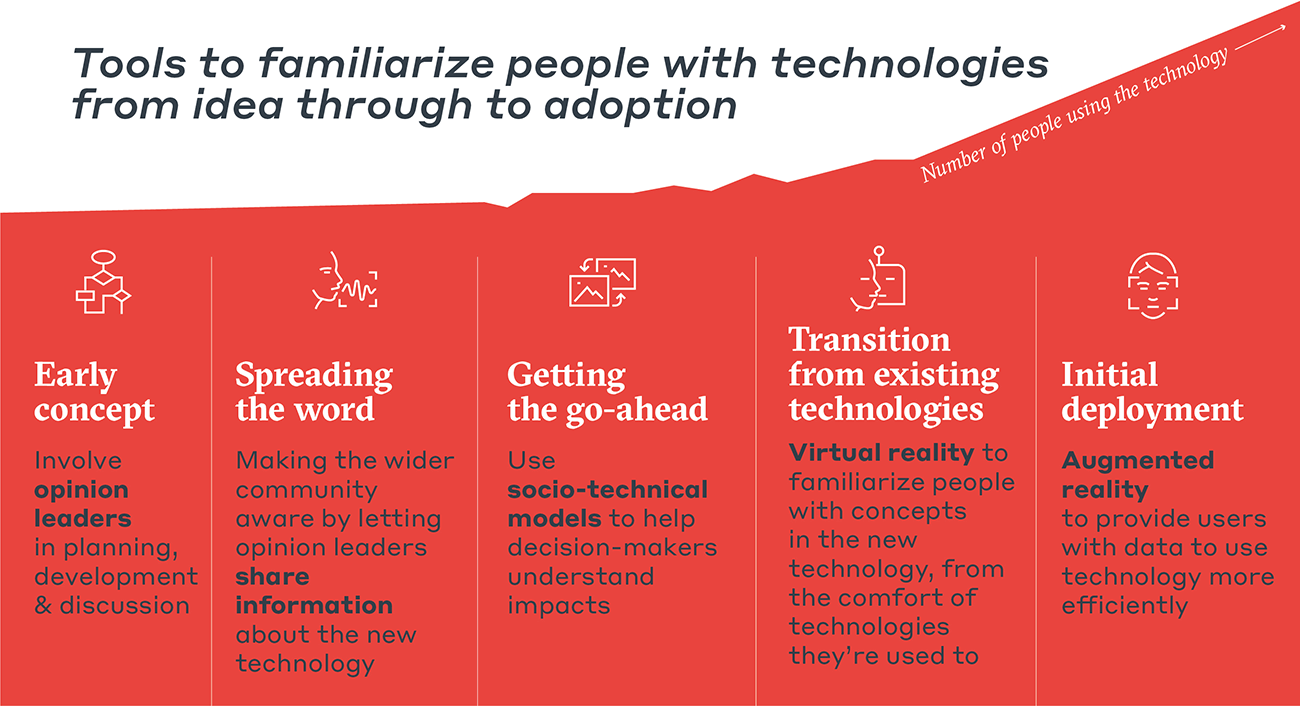
1. Involve credible opinion leaders in the planning and development phases
For greater familiarity and greater optimization of its benefits, people should be aware of the technology well before it’s developed. Involving credible opinion leaders in the planning and development phases means that they’ll be sharing information about possible uses, benefits and pitfalls as the technology develops – bringing the wider community of early adopters along on the journey. If opinion leaders and early adopters see and share the benefits of the technology, and want to use it, they will convince later adopters to use it too. Moreover, integrating relevant stakeholder feedback in the product development process can enhance the applicability of a technology and mitigate certain upfront risks of new technology deployment.

2. Share information about uptake in the community
Word of mouth, spread by early adopters and opinion leaders, is a way of spreading knowledge and decoding the technical aspects of new technology into familiar and understandable ideas. The more people learn about early adopters and opinion leaders using the technology, the more comfortable they’ll be to try it themselves. The use of word of mouth and other communication tools like marketing ads is a strong indication that the technology is starting to transition into being mainstream.

3. Visualization through sociotechnical models
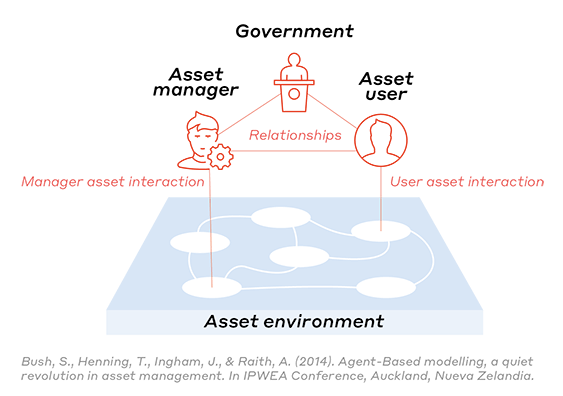
Parallel to information sharing, decision-makers must understand how the technology will be integrated into existing systems and the effects it will have on existing systems. Will it disrupt them or will it make it easier for them to achieve their aims? Will they have to build new infrastructure to accommodate the new technology? Providing models that show how the technology would fit into the flow of the existing system is critical. Using an agent-based model is one way of identifying potentially unexpected behaviours and outcomes arising from introducing new technology.
4. Virtual reality
Virtual Reality (VR) has proven hugely valuable to ensure people use new technology correctly and are aware of the wider benefits. In the design of hospitals, for example, staff and patients have been able to provide feedback that results in better user experience and more productive health care. The use of VR in the design of automated vehicles and related transportation systems could help us understand the user experience, for a much smoother initial rollout. Further, as we transition to fully automated vehicles, there will be instances in which drivers are still able, or expected to, react. In test scenarios, drivers often fail to react because they trust the system to take full control. Studies show that drivers who had VR training before driving an automated vehicle were more likely to understand and react to potential risks [4]. Including VR headsets in driving schools would ease the automated vehicle transition. VR can also be used to create a deeper understanding of how automated vehicles operate. In VR, the driver would be able to see a real-time visual representation of how the car processes sensor data such as road signs, traffic lights and other vehicles. This training would lead to a greater level of acceptance and trust. The use of VR will be akin to flight simulators that pilots use for certification.

5. Augmented reality
As automated vehicle technology advances, other fields of technology could be embedded to improve the functionality and reduce risks. Augmented reality can provide real-time information to the driver using Level 2 or 3 automated vehicles. (footnote 1) Augmented reality would work in conjunction with the car’s sensors to provide real-time feedback to the driver regarding hazards – allowing the driver to take appropriate actions.
Considering infrastructure and transportation systems as integrated, coordinated socio-technical systems is crucial when developing new technology, and is an essential aspect of intelligent infrastructure. New technologies are only as effective as adoption allows; people must be prepared to use these technologies if they are to fulfill their purpose and improve our lives.