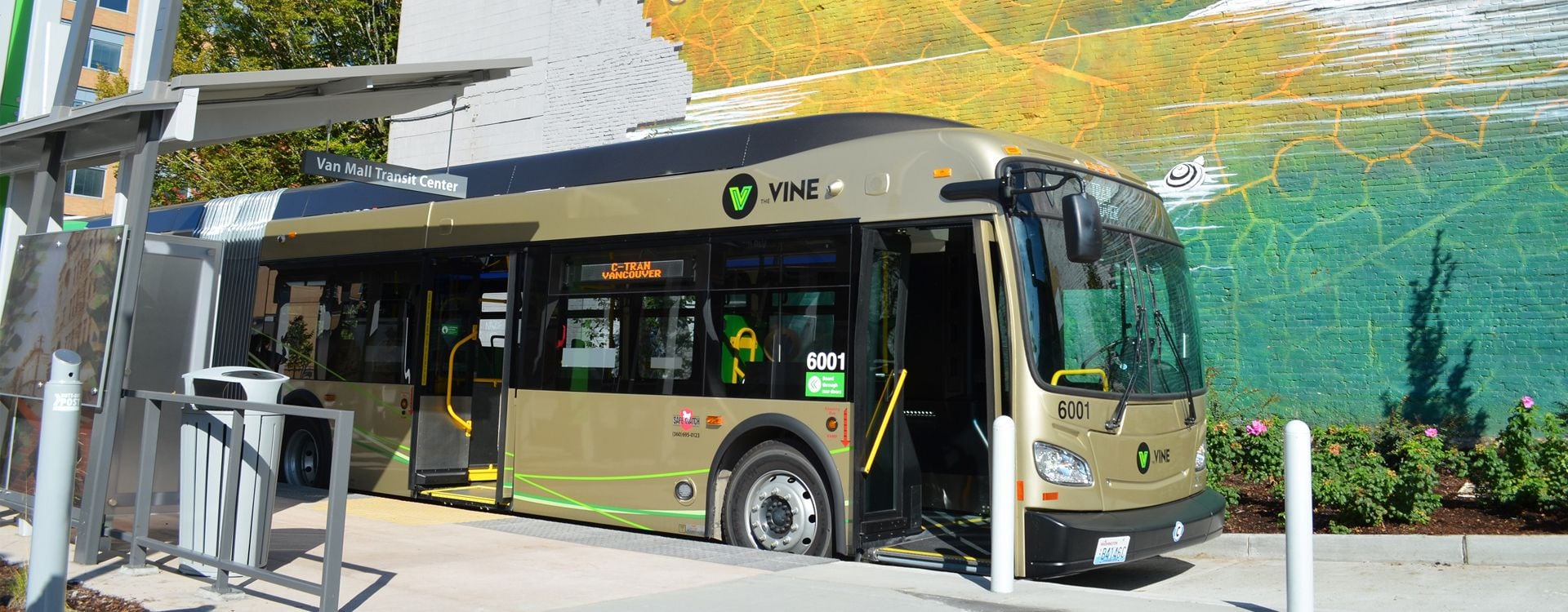
The Vine, a six-mile bus rapid transit (BRT) system in Vancouver, Washington, offers enhanced transit services using low-floor, 60-foot-long hybrid buses operating in mixed traffic.
The Clark County Public Transit Benefit Area Authority (C-TRAN) launched service on Jan. 8, 2017, culminating a six-year effort to bring improved transit services to Fourth Plain Boulevard in Vancouver, the most heavily used transit corridor in C-TRAN’s system. WSP USA designed the BRT. Prior to this project, two previous fixed local bus routes carried more than 30 percent of C-TRAN’s ridership.
The $53 million line is the first BRT system to serve the Portland-Vancouver metropolitan region. The route serves 17 stops and stations along the Fourth Plan and Fort Vancouver Way corridors, between downtown Vancouver and the Vancouver Mall.
The Vine BRT offers numerous other benefits, including
- rider amenities, such as upgraded stations and real-time passenger information;five new signalized pedestrian crossings, wider sidewalks in station areas and bicycle lane system improvements;
- safety features including open sight lines, improved lighting, security cameras, graffiti- and vandal-resistant materials, and real-time user information;
- better connection and access to area businesses and employers, providing for greater awareness and visibility for existing business owners; and
- increased transit capacity, decreased transit operating costs, and more efficient and cost-effective service overall for C-TRAN.
- The project also features GPS-based transit signal priority and off-board fare collection.
In addition, the project relocated the Vancouver Mall Transit Center, creating an eight-bay facility that includes a covered walkway connecting the station and the mall entrance.
WSP started work with C-TRAN on the project in 2009, initially serving as the primary sub-consultant for the Clark County High-Capacity Transit Study that led to the idea of bringing BRT to Vancouver. That study investigated priority corridors for high-capacity transit improvements, established BRT as the preferred high-capacity transit mode, and identified Fourth Plain Boulevard as the highest-priority corridor for BRT implementation.
In 2012, the firm completed the Fourth Plain Transit Improvements Alternatives Analysis, which led to the selection of a locally preferred alternative for the Fourth Plain corridor. One year later, WSP was selected to provide final BRT design, which eventually led to the project’s approval for the maximum of 80 percent federal funding through the Federal Transit Administration (FTA) Small Starts Program.
The WSP team completed the Alternatives Analysis approximately $150,000 under the contract budget and within a tight 13-month schedule in order to have a locally preferred alternative in place by July 2012. WSP was also responsible for station design, urban design, traffic analysis and transit signal priority, environmental analysis and documentation, cost estimating, a maintenance facility plan expansion and remodel, community outreach and public involvement support, scheduling, risk management and design services.





.jpg)