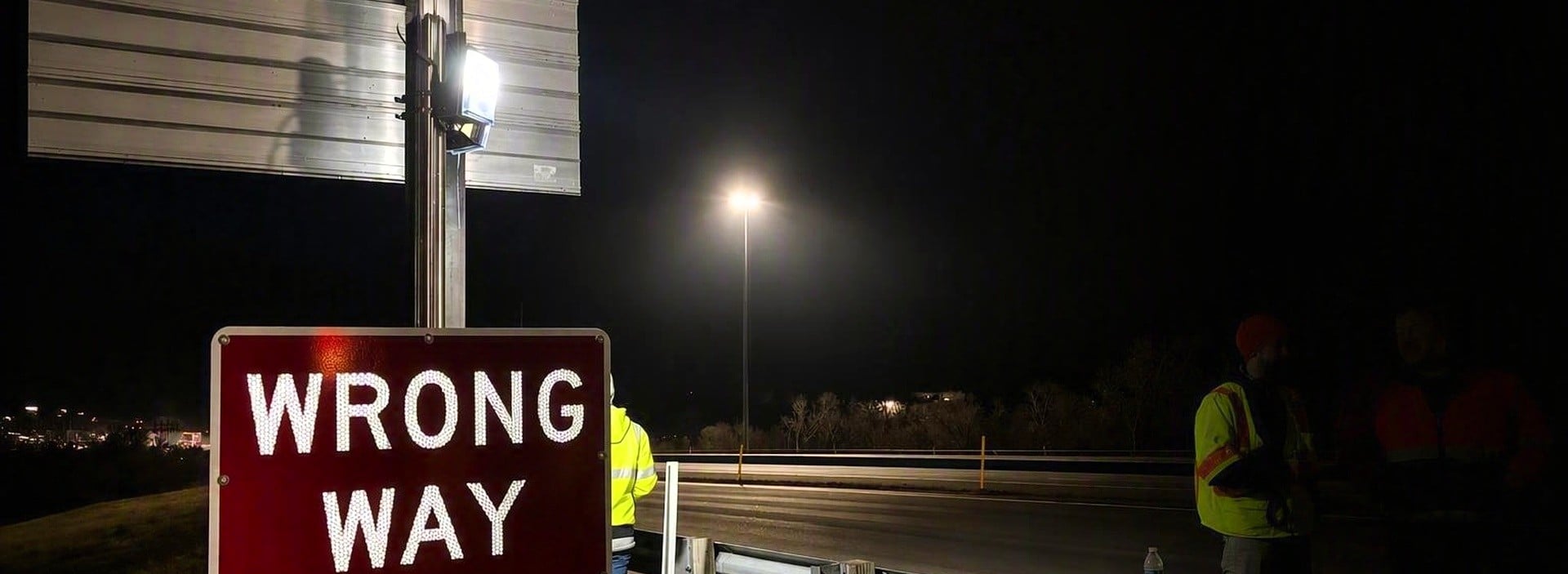
Road safety in cities like Louisville and Lexington extends beyond traffic management. It is about protecting people, keeping communities moving and enhancing everyday mobility.
As the Commonwealth’s authority responsible for transportation, the Kentucky Transportation Cabinet (KYTC) carries that responsibility on behalf of cities, drivers, emergency services and local economies.
Research shows that at least 88 wrong-way driving crashes were documented in these regions between 2015 and 2020, yet KYTC knows this figure only tells part of the story. Not every incident was recorded at the time, and the actual number of wrong-way events is widely understood to be much higher.
What makes the issue so urgent is the severity of its consequences: wrong-way driving crashes disproportionately lead to fatalities and life-altering injuries, putting both road users and first responders at risk. Each serious incident also forces interstate closures that can last for hours, causing major traffic congestion, disrupting daily life and creating significant economic costs for cities and businesses.
Faced with a problem that affects safety, mobility and prosperity all at once, KYTC set out to find a smarter, more proactive way to act, and partnered with WSP in the U.S. to help turn insight into prevention.
Designing solutions as a system
Against this backdrop, the challenge was not to deploy a single technology, but to define how the transportation system as a whole could respond more effectively to wrong-way driving.
Working alongside the KYTC, we supported the program from the outset, helping to frame the problem at a system level and align stakeholders around a shared approach.
Securing the funding to act on that vision was a critical step in turning it into reality. We collaborated with KYTC to develop the agency’s federal grant application, turning a complex safety challenge into a clear, compelling case for investment.
This meant aligning technical, operational and strategic priorities with federal ITS requirements, while demonstrating how the program could deliver measurable, scalable impact. With that foundation in place, KYTC was able to move forward with confidence.
“
Within our role as a strategic and technical partner, we focused on three closely related responsibilities,” said Christopher Barrow, project lead and expert in integrated traffic and safety systems, WSP in the U.S.
How the integrated system responds in real time
First, we designed the overall concept of operations, defining how detection, deterrence, alerts, existing infrastructure and operational workflows should function together under real-world conditions.
In practice, the system responds the moment a vehicle enters an off-ramp in the wrong direction:
- Step 1: Detection. Technologies that combine new sensors with existing roadside cameras identify the errant movement immediately and trigger warnings.
- Step 2 and 3: Escalation and alerting. If the vehicle continues, operators are alerted, overhead signs warn approaching drivers and emergency services are notified.
- Step 4: Network Response. Meanwhile, mainline monitoring allows operators to track the vehicle and manage risks across the network.

Second, we translated that system design into technically and operationally achievable solutions, supporting KYTC in defining program requirements, aligning them with the existing ITS architecture and guiding the evaluation and selection of delivery partners.
“We defined clear performance criteria for detection, deterrence and alerting, and evaluated a range of solutions, including radar-, LiDAR- and video-based frameworks, based on their ability to perform reliably under everyday conditions and evolve over time,” Barrow said. “This ensured that selected partners and technologies moved beyond standard solutions, setting a higher benchmark for performance and ensuring selected partners and technologies would remain effective as part of a long-term, integrated system.”
Third, we helped ensure the program would be supported by consistent performance tracking, repeatable methods and designed for expansion.
“By establishing test and evaluation frameworks and developing technical standards that could be applied consistently across corridors and, ultimately, statewide, we embedded performance measurement from the outset,” he added. “Rather than treating deployments as stand-alone pilots, systems were tested under realistic conditions, including different vehicle types, speeds and environmental factors, to ensure reliable performance.”
These insights were used to refine requirements and establish consistent standards, allowing each deployment to build on the last. This created not just a functioning end-to-end program, but a scalable, data-driven model for statewide implementation.
Leading the shift to integrated safety systems
What sets the program apart is not a single technology, but the way multiple technologies, data streams and operational processes are brought together into a coordinated program.
“This is where it really comes together,” Barrow said. “Rooted in a Transportation Systems Management and Operations (TSMO) approach, the program connects detection, deterrence, alerting and corridor monitoring into a continuous feedback loop, where data is collected, analyzed and used to inform instant operational decisions.”
He added that the TSMO approach allowed them “to move from reactive response to insight-driven action, so the network can adapt as conditions change.”
From deployment to real-world impact
The program is now moving into the construction phase, with systems being retrofitted across selected sites.
“We’re now deploying across active locations, with mainline monitoring already in operation alongside ramp-level interventions,” Barrow said. “As we move through installation, the focus is on making sure everything works together under actual conditions. By the end of the year, the full system will be in place and fully operational.”
For Barrow and his team, the project goes beyond delivering a technical solution.
“It’s about pushing the boundaries of what’s possible and combining innovation with real-world operations to address a very real safety challenge,” he explained. “At its core, we’re working to prevent crashes with life-changing consequences.”
That means not just designing systems, but improving how safely people travel every day.
“It’s this combination of impact and innovation that makes the project both challenging and rewarding,” he added. “Doing something new and knowing it matters.”