COVID-19 has been dubbed a “black swan” event – those unexpected occurrences which can be understood as low-probability, high-impact economic events or market movements. Black swan events are seen as outlier scenarios that are hard to anticipate, but can have major, long-lasting impacts.
Climate change represents another threat to the global financial system, and carries the risk of what some are calling “green swans”: climate-related events that cause significant disruption to the global economy, social, and natural systems. While we understand the general possibility of global shocks like climate change and pandemics, the full extent of their impacts, systemic interdependencies, and the effects that follow are difficult to predict and to manage. Are investors and companies adequately preparing for the cascading, interconnected impacts of climate change and the outcomes that “green swans” may bring?
Economic impacts of climate change
We have already seen increased prevalence and probability of extreme weather such as flooding and forest fires, droughts, and shifting weather patterns, which directly impact markets and economies. Their impacts are complex and interconnected, including increased disaster recovery costs, loss of business continuity, shifts in resource availability and commodity pricing (among other factors). Transition risks to economies are also expected as governments introduce carbon pricing, markets unveil new technologies, and consumers shift preferences.
| Type of risk |
Economic outcome |
Timing of effects |
|
Physical risks
|
From extreme weather events
|
Unanticipated shocks to components of demand and supply
|
Short to medium term
|
| |
From increased temperatures, changes in weather patterns, etc.
|
Slow-onset impacts to productive capacity and economic growth
|
Medium to long term
|
|
Transition risks
|
From market and policy shifts in the transition to a low-carbon economy
|
Demand/supply shocks or economic growth effects
|
Short to medium term
|
Adapted from Batten, 2018
The Bank for International Settlements (BIS) recently released a book illustrating how green swan events cause unexpected and severe impacts, disrupting economies and financial markets. In fact, climate change causes such complex and unpredictable chain reactions across financial, social and natural systems, that green swan events may pose an even greater risk to humanity than a traditional financial crisis.
Low probability, high impact
“Tail risks” in finance and economics refer to market movements that are considered mathematically low probability — they are contained in the “tail” of the distribution of possible market events. These events are colloquially known as black swans and have long-lasting impacts on social and economic systems.
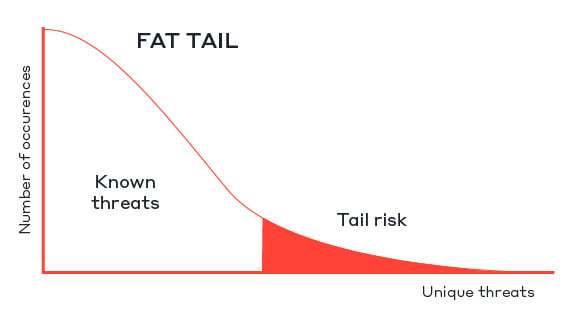
Adapted from SecurityRoundtable.org
Climate change can cause tail risks through two mechanisms:
1. Slow-onset events
The slow onset of climate change can lead to complex, cascading effects through the economy. For instance, long-term decreases in precipitation in key agricultural regions will decrease crop yields, resulting in higher commodity prices. If the droughts persist, long-term changes in prices and availability can further result in shifting supply chains and changes in market preferences, with cascading effects on the agricultural industry and food security. Further, if government policy is not sufficient to adapt to slow-onset climatic changes, by the end of the century, the impacts to our natural systems may be so severe that the economy as we know it would not be functional.
2. Extreme events
Climate change increases the probability of extreme weather events, such as one in 1,000-year storm or flooding events, more frequent and intense forest fires, and deadly droughts or heatwaves.
Additionally, climate scientists have identified a set of “tipping points” – thresholds that when surpassed, could cause dramatic and irreversible shifts in the planet’s climate system. Some projections have found that some tipping points may be reached sooner than anticipated, and with greater consequences.
Like we have seen in the COVID-19 response, governments can be slow but also aggressive in acting to mitigate the effects of black-swan events. As the effects of climate change become increasingly clear and/or tipping points are reached, the policy response by governments around the world may be forceful, abrupt, and disorderly.
These examples represent green swans – low-probability economic impacts caused by either the gradual or sudden effects of climate change. Similar to COVID-19 and other black swan events, investors and companies need to prepare and stress test for the impacts of green swans.
Green Swans as financial risks
Many investors, asset owners, and companies are already assessing climate change risks to their portfolios and businesses, and disclosing those risks through the Taskforce for Climate-Related Disclosures (TCFD). The process includes using historical data and future scenario models to evaluate the impact of climate change on portfolio returns and revenue.
While current climate models can reveal material risks to business, they are not capable of assessing the macro and micro economic impacts of tail risks for large, diversified portfolios (although efforts are being made). As climate change accelerates and presents new and complex systemic risks, backward-looking analysis is not necessarily useful. What’s more, the models often assume a steady, linear rollout of carbon pricing, incremental warming of temperatures, and gradual increases in the frequency and severity of extreme weather events such as floods, fires, and storms. They are therefore not adept at handling abrupt and unexpected tipping points.
Current models leverage historical experience to assess the ability of the business to absorb these changes, and they depict the influence of climate change on the macroeconomy that, while meaningful, occurs continuously over several decades with the most significant impacts manifesting in the latter half of the 21st century. Most crucially, the possibility of a green swan shock to the economy is typically not being assessed.
Building resilience to green swan events
Building resilience to climate change requires building resilience to the possibility of unlikely yet impactful green swan events. We recommend the following considerations to help investors and companies understand and plan for such extremes:
- Conduct science-based stress tests that assess how portfolios would be impacted by low probability but high-impact economic shocks caused by climate events. Assessments should include climate-related economic tail risks driven by slow onset changes, extreme events, surpassed tipping points, and rapid shifts in climate policy.
- Assess the cascading effects and interdependencies associated with tail risks, and how they could impact the portfolio. This would require focusing on specific climatic thresholds and feedback loops, then connecting the impacts to a broad range of industries and changes in macroeconomic variables.
- Impacts to long-term portfolios with higher climate risk exposure, such as infrastructure, should be examined more closely and qualitatively.
- Develop signposts and metrics that can indicate when a risk is increasing, and develop a plan of action once that signpost is reached.
Organizations need to rely on experts with a deep understanding of climate science, risk interdependencies, operations, supply and value chains, who are equipped to help investors and asset owners prioritize climate risks and mainstream resilience into their investment strategy. Preparing for the unlikely but extreme impacts of climate change will help investors understand and manage the effects of tail events and green swans that we may face in the future.
WSP’s climate team and our Future Ready® program supports clients in understanding the implications of future climate scenarios, acute climate shocks and tail events across their portfolios and assets.