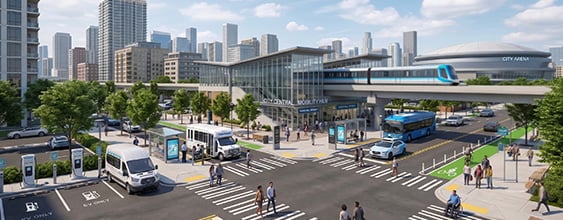
Transportation agencies are preparing for tomorrow’s interconnected environment, where vehicles, infrastructure and road users seamlessly communicate.
This future is enabled by connected vehicle (CV) and Vehicle-to-Everything (V2X) technologies built on consistent standards, proven deployment strategies and rigorous testing.
Leading the charge for this compatibility is the Connected Vehicle Pooled Fund Study, an ongoing national research program to advance V2X capabilities in ways no single transportation agency could manage alone.
Managed by University of Virginia, providing technical and administrative leadership, the pooled fund brings together 24 state and local transportation agencies to support this future, creating a collaborative environment where members can collectively choose research priorities, pool resources and harness shared technical expertise.
Collaborative impact
The pooled fund model is about shared ownership. Member agencies each contribute funding, insights and operational expertise, and together they determine which projects to pursue. This ensures investment in actionable, real world needs instead of academic exercises or isolated pilot projects.
Even agencies unable to formally join still gain access to many of the study’s deliverables, resulting in a national interoperability laboratory that is bringing the future closer.
WSP is playing a leading role in this effort, as we’re currently managing four of the seven active pooled fund projects:
- Connected Intersection Project
One of the core pooled fund efforts, the Connected Intersection Project (CIP) evaluates how well existing deployments adhere to the “ITE CTI 4501 Connected Intersection Implementation Guide,” a nationally recognized guide that defines how signalized intersections should be implemented to reliably communicate with connected vehicles in an interoperable way.
We have conducted extensive testing across Utah, Georgia, Ohio, Virginia, California, and Arizona, reviewing message content, communication range, latency and MAP message geometry. This work provides foundational insights for agencies preparing to deploy or expand connected intersections, which are equipped with communications technology that allows traffic signals to broadcast real time information to connected vehicles and other road users.
By documenting message quality, geometry accuracy and end to end system performance, the study equips agencies with real world knowledge that reduces deployment risks and promotes consistency.
- Connected Intersection Message Monitoring System
While the CIP evaluates deployments, the Connected Intersection Message Monitoring System (CIMMS) project focuses on monitoring the real-time performance of messaging between intersections and vehicles. We are designing a prototype system capable of analyzing messages, detecting errors and alerting system owners to potential issues.
The system incorporates five custom algorithms that assess everything from signal state conflicts to misalignments between geometry data and observed vehicle paths. The prototype is now being deployed in Utah and Maricopa County, offering agencies a practical tool for long term message performance monitoring.
- V2X Device and System Procurement Project
Procurement of V2X devices and systems – such as a field-installed roadside units that broadcasts V2X messages from a signalized intersection to connected vehicles – is often one of the most challenging phases of a connected vehicle program. This pooled fund project provides agencies with structured guidance on this process and draws input from original equipment manufacturers, integrators and suppliers. This allows agencies to develop procurement packages that reflect evolving standards and best practices, while ensuring interoperability and future readiness.
- V2X Onboard Unit Guidance Project
As onboard unit deployments – the in-vehicle counterparts to the roadside units – scale across the U.S., agencies need more consistent guidance on configuration, security, applications and testing. This project delivers such guidance, with a framework that complement the CIP, CIMMS, and Procurement projects, ensuring that both roadside and in vehicle components align with national standards and produce consistent outcomes across deployments.
Real world deployments
The pooled fund’s research is being enriched by the practical experience of active, large-scale deployments across the nation from its membership, such as the Maricopa County’s Connected Vehicle Acceleration Zone (CVAZ) and the Marysville Onboard Unit (OBU) Integration Project.
The CVAZ program is one of the country’s most ambitious connected vehicle initiatives. Covering Phoenix, Tolleson, Avondale and major freight corridors along Grand Avenue/U.S.-60, the project includes the installation of 750 roadside units that support emergency vehicle preemption, transit signal priority, vulnerable road user safety, freight signal priority and network V2X applications.
Our firm has a GEC contract with the County and is responsible for leading the systems engineering, procurement documentation, test plans and overall program management for the CVAZ project. Insights from this deployment are informing the pooled fund’s understanding of large scale, multi use case CV ecosystems.
Then there’s the Marysville OBU Integration Project, which was part of Ohio’s 33 Smart Mobility Corridor in 2023. For this project, we integrated and tested onboard units in 400 private vehicles, validating applications ranging from red light violation warnings to pedestrian in crosswalk alerts.
The project provided critical testing on message reliability, safety applications, HMI design and system behavior – experience that also informs the pooled fund’s OBU guidance work.
Kindling momentum
Recent V2X testing across the country has proven to be increasingly consistent, and while not every requirement is achievable with today’s technology, agencies are steadily converging toward common standards and practices.
But this momentum requires constant maintenance, which in turn demands coordination, engagement and regular feedback from agencies. We support this process by convening frequent meetings, promoting open reviews of guidance documents and ensuring that agencies remain active participants throughout each project lifecycle.
The Connected Vehicle Pooled Fund Study represents one of the country’s most important collaborative efforts to advance V2X technology. Its work ensures that connected vehicle systems are not developed in isolation, but rather through shared knowledge, consistent standards and rigorous testing.
Visit our website for more information on WSP’s connected and automated vehicle projects.