What have you been able to accomplish/learn on your emissions reduction journey so far?
WSP and I quantified the carbon emissions related to my travels and accommodation for the past two years, and are currently gathering data for my third year. Every year, we compensated what could not be avoided. We are finding ways to reduce my carbon emissions and see the difference in the data depending on what actions I am taking.
GHG Emissions by Source
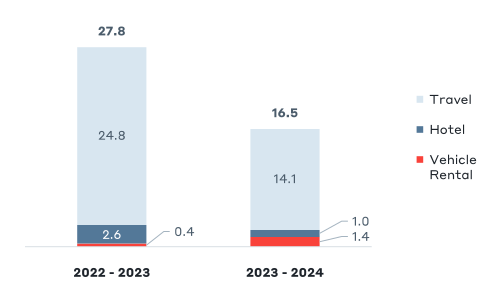
Airplane travels are the most emissive activity, which led to another phase of the project. We are working on standardizing the method I am using to quantify my emissions for other athletes to easily use it. The goal is to gather the carbon emissions related to air travel of the whole aerials world cup circuit and present a report to FIS (the International Ski Federation) with suggestions for a more travel-efficient World Cup calendar that would minimize air travel, backed up with data.
I also put energy towards reducing the carbon footprint of events I am competing in. We are hosting a World Cup event in Canada and, last year, I collaborated with the organizing committee to implement sustainability measures. I received the OLY Legacy Grant from the Canadian Olympic Committee and used this money on the measures we implemented for the event. For next year, we are looking to implement new measures and further reduce the environmental impact of the event by collaborating with WSP and Racing to Zero, a non-for-profit led by a Canadian Olympian in field hockey, Oliver Scholfield. I learned that there is a lot of logistics behind events, but that dedicated people within an organization can truly make a difference.
My involvement was noticed by people in the sports community which gave me other opportunities from which I learned so much and met inspiring people: I am a member of Protect Our Winter's athlete alliance, I was involved in Green Sports Day, I am the sustainability ambassador of the OLY network group in Canada and I am an intern of in the sustainability department of CAE. Projects related to these opportunities are ongoing. I gave conferences on climate action in schools and learned that kids are aware of the climate crisis, but sometimes feel powerless. I am trying to empower them to make changes in their small community since this work will eventually add up. I am trying to do the same in my community.
How have you applied this to your everyday life?
The main takeaway I have from learning about sustainability is that we need to consume less, of everything, and that it is possible to live our daily life without constant excessive consumption. I converted my bike to an electric bike, allowing me to ride to training everyday instead of taking my car. I significantly reduced my meat consumption. I am buying more second hand and local goods. I started to use car-sharing services for longer travels.
Without really noticing, I became an advocate as well. I am using my athlete platform to share my values and the importance of individual action, but I am also using my voice to have influence over bigger stakeholders, which I do through my above-mentioned projects.
What has been your reaction to the efforts made by the organizers of the Paris Olympics to reduce their carbon emissions?
I think they set very ambitious goals and that this is exactly what we need. The Olympics is an event which influence spans broader than sports and that the effort they are putting towards sustainability will become mandatory for the next editions of the Olympics. Sports and the environment are closely intertwined, and it is our responsibility as athletes, federations, event organizers to show the example when it comes to sustainability.
What do you feel we can learn from the goals/initiatives from Paris that can be applied to future Olympic Games?
Paris 2024 aims to be the first Games that align with the Paris agreement guidelines; cutting the carbon emissions in half compared to previous editions of the Games, setting a cap on carbon emissions prior to the event, assessing the impact of the Games on biodiversity and restoring what will be affected, among others. As the global temperature is warming, it has been estimated that by 2085, only 30 cities in the Northern hemisphere will be cool enough to host the Olympic Games. Therefore, the future editions of the Olympics will have to consider sustainability as a key pillar.
Climate Action at the Paris Olympic Games
|

50% Less Carbon Footprint
|

All Venues Powered by Renewable Energy
|

Proximity of Olympic Venues to Olympic Village
|
I think we will learn from Paris 2024; which measures had the best impact compared to the cost they represent, what could have been better, what worked very well, how did these measures affect the athletes (positively or negatively).