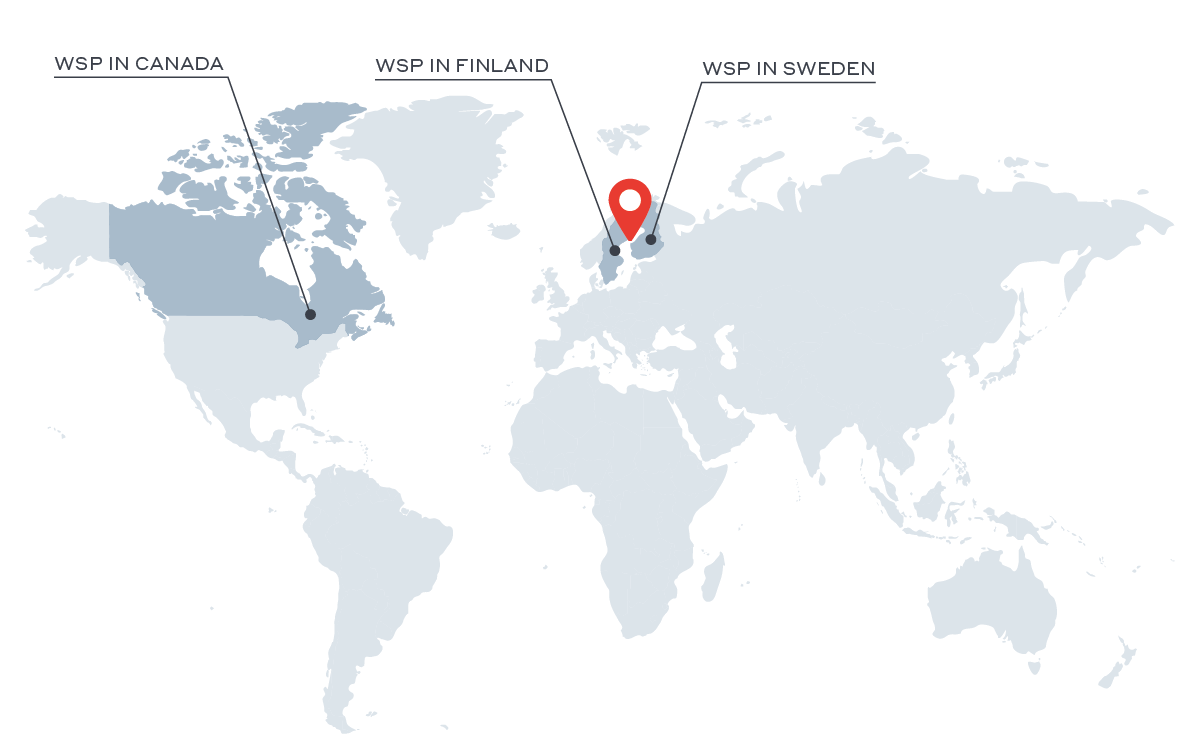
The Finnish Transport Infrastructure Agency has commissioned WSP to study traffic demand and conduct a feasibility study for a fixed link between Umeå, Sweden, and Vaasa, Finland. The needs assessment will examine traffic forecasts and evaluate impacts. The feasibility study will consider, among other things, the constructability of the link, maritime operational conditions, environmental factors, and sustainability.
The assignment is based on a government program entry that calls for a study of a fixed link across the Kvarken Strait (Vaasa-Umeå), while also examining the synergies of electricity and hydrogen transmission connections.
The distance between Umeå and Vaasa is approximately 100 kilometers, with the shortest distance between the coasts being about 80 kilometers. Currently, the route is serviced by a ferry with a travel time of 3.5–4 hours. The vision of a fixed link across the Kvarken Strait has existed for a long time, and it has now been included in the government program.
A fixed link is a very technically challenging project. The crossing requires finding technically-feasible solutions to ensure the link’s constructability. Surface solutions are challenged by sea currents and ice movements combined with storm winds. In addition to technical challenges, the Kvarken Strait is an environmentally-sensitive area with extensive nature reserves.
An underwater link would mean a significantly long tunnel. Currently, the world’s longest undersea road tunnel (about 27 km) is under construction in Norway. The world’s longest undersea railway tunnel (about 54 km) is in Japan. In the case of the Kvarken Strait, these lengths would be exceeded.
WSP has assembled an international expert group from Finland, Sweden, and Canada to bring comprehensive expertise to the task.