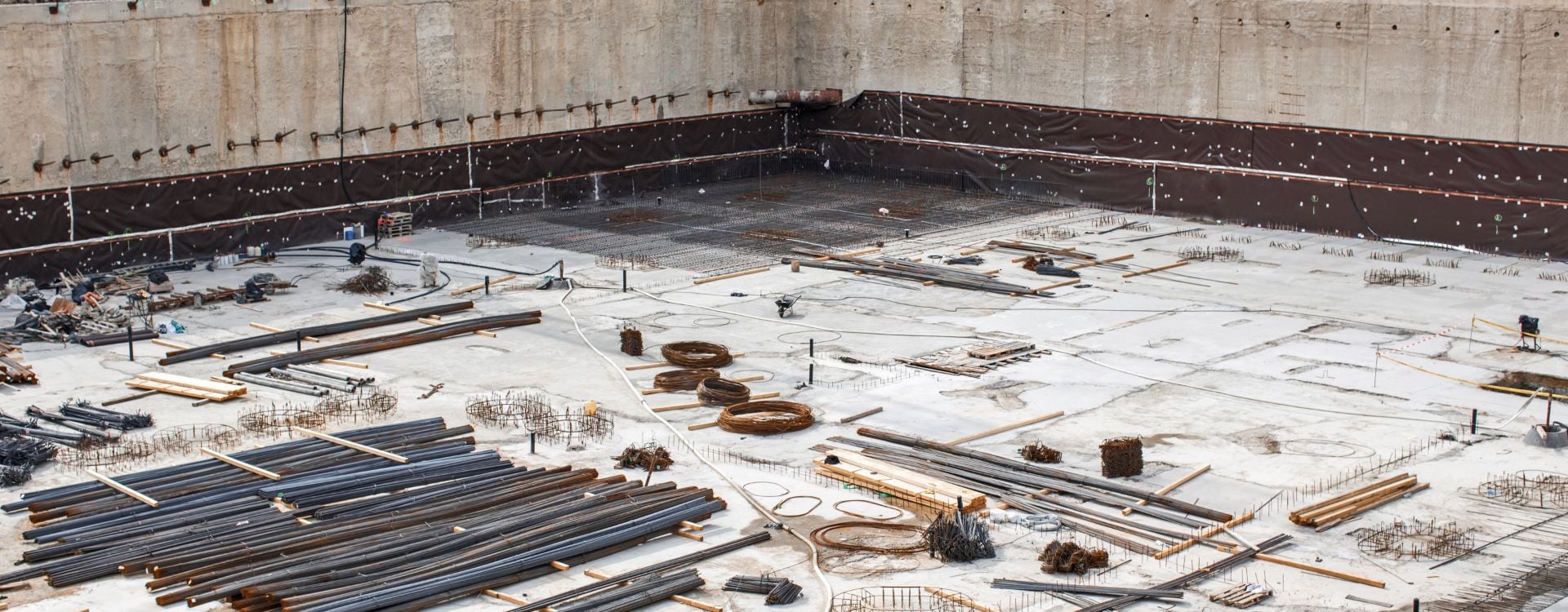
Deep excavations and slopes can deform and even collapse, often with little warning. This risk is particularly pertinent when considering land development for building projects and infrastructure projects. Whether it involves excavating the ground to construct basements for tall towers or tunnelling underground to create new metro stations, these scenarios carry inherent dangers.
Dr Chris Haberfield, a Senior Consultant – Geotechnical, with WSP, has more than 40 years of experience in this field and a great deal of insight into what can go wrong, how it happens, and how to mitigate the significant risks involved. Here he shares his insights and recommendations to assist project developers, designers and builders to recognise the risks involved in constructing deep excavations, invest in understanding ground and groundwater conditions, and design and construct to manage risk and limit movement.
Each project is unique
Chris says that there are many reasons for greater than expected movement or collapse of basement retention systems, but that nearly all are related to overly optimistic or unsatisfactory design and/or failure to follow or achieve the design or design intent during construction.
“Every basement retention system is different and has its own unique set of risks,” he says. “Precedence can assist – but it can’t be relied on. Just because something has ‘worked’ on a past project, it doesn’t mean that it will work on this project.”
He says that every retention system must be independently designed (and reviewed) by a competent and experienced geotechnical engineer for the specific conditions at the project site.
“This means taking the time to understand the particular local geology and hydrogeology and the elements at risk,” says Chris, “so that hazards can be identified and mitigated.”
One of his top recommendations for good design is to think about the big picture before looking at detail.
“Think carefully about what the project needs to achieve, what you will do to the ground and groundwater, and how both will respond,” he advises.
Experienced geotechnical professionals mitigate risk
The most significant risk mitigation measure is engaging a team of specialists who can apply the right level of diligence, insight and caution to a project.
“Experienced geotechnical professionals help avoid failures stemming from incorrect analysis, inappropriate tools or models, or insufficient understanding of the geology, hydrogeology and geological history,” he says. “This is critical to understanding the ground and groundwater hazards and behaviour.”
Furthermore, in an era where climate change and extreme weather events are becoming more frequent, being Future Ready™ in and creating resilient buildings is very important.”
“We’ve seen numerous examples of misunderstanding or overconfidence relating to strength and deformation parameters, material behaviour and potential failure mechanisms, in situ horizontal stresses on the retention system design, and movement or failure mechanisms independent of those caused by lateral earth pressures, for example, vertical settlement of retention system piles in soft ground or from poor installation.
“We’ve also seen settlement and damage arise from inadequate consideration of groundwater conditions, especially in soft clay,” he explains.
He stresses that designers must avoid being too optimistic about the impact of dewatering.
“Designers should consider seepage of groundwater through the retention system walls and identify the potential for buried paleo channels resulting in uncontrolled seepage beneath the wall,” he says.
Chris says that unusual but credible events that could affect the project should also be taken into account. For example, a sudden rise in groundwater level in permeable ground (including rock masses) due to events such as failure of a water main, flooding or torrential rain.
“How much movement is too much is a difficult decision that must be made by all stakeholders, including those at risk,” says Chris.
“If there isn’t enough consideration of what constitutes ‘acceptable movement’, the retention system may turn out to be too flexible. Lateral movement of the retention system will likely result in settlement behind it.”
He points out that it is also important to analyse weak conditions such as service pipe trenches and fill, which could lead to local failure between retention elements.
“Caution is needed to ensure sufficient redundancy in the retention system, such as tying sections together using a capping beam and walers,” he explains, “and to ensure that the design is based on realistic – not overly optimistic – expectations of the performance of elements such as anchors and piles.”
Detailed documentation is essential
According to Chris, even with a well-considered design, things can come unstuck if contractors don’t involve the designer, or don’t fully understand the risks.
“It’s crucial that the retention system is installed according to the engineering drawings, that advice is on hand to resolve problems as they arise, and that adequate monitoring is conducted to detect emerging issues,” he states.
Drawings and documentation are a key area for attention.
“It’s vital to have sufficient detail on the construction drawings,” says Chris, “especially in respect to construction of piles and anchors, sequencing and required quality assurance and supporting documentation. Insufficiently detailed construction advice often leads to construction sequencing that is inconsistent with the design intent.”
He recommends that construction professionals ensure that adequate quality assurance documentation is in place regarding the installation of components of the retention system (particularly piles, anchors, dewatering and struts). This documentation must be reviewed to ensure the design intent is achieved. He emphasises that anchor installation should be appropriate for the ground conditions and anchors that fail the proof test must be replaced.
The importance of monitoring
Chris also draws attention to the importance of monitoring movement and groundwater levels in the construction stage.
“The designer will need to review monitoring data in a timely manner to ensure that retention and dewatering systems are performing in accordance with the design,” he says.
“Regular monitoring of movement and comparison of this data with expected movement gives early warning of non-performance. This allows mitigation measures to be implemented before movements become problematic. Monitoring of groundwater levels (where applicable) both inside and outside of the excavation will help avoid construction difficulties, unplanned drawdown and ground movement.”
Learning from past experience
Unfortunately, there are many examples across the world where projects involving deep excavations have resulted in risks or injuries to workers, damage to property and major financial consequences.
“These cases show that there is a vast range of aspects to consider when designing and constructing retention systems,” he says, “and each element is integral to the project proceeding safely and achieving the desired outcome.”
To find out more contact Dr Chris Haberfield, Senior Consultant, Geotechnical & Tunnels.
About the author:
Dr Chris Haberfield is a Senior Consultant with WSP. He has over 40 years’ experience and is internationally recognised for his work on soft, weak and weathered rock – in particular the analysis, design, laboratory and field testing, construction techniques and response of engineering works in these materials. He has extensive experience in piled foundation design and analysis, numerical (including advanced finite element) and analytical modelling, laboratory and field testing of geomaterials, stress analysis, ground structure interaction problems and slope stability analysis.
To stay abreast of our latest information, publications, videos and posts, please subscribe to our news or follow us on LinkedIn.