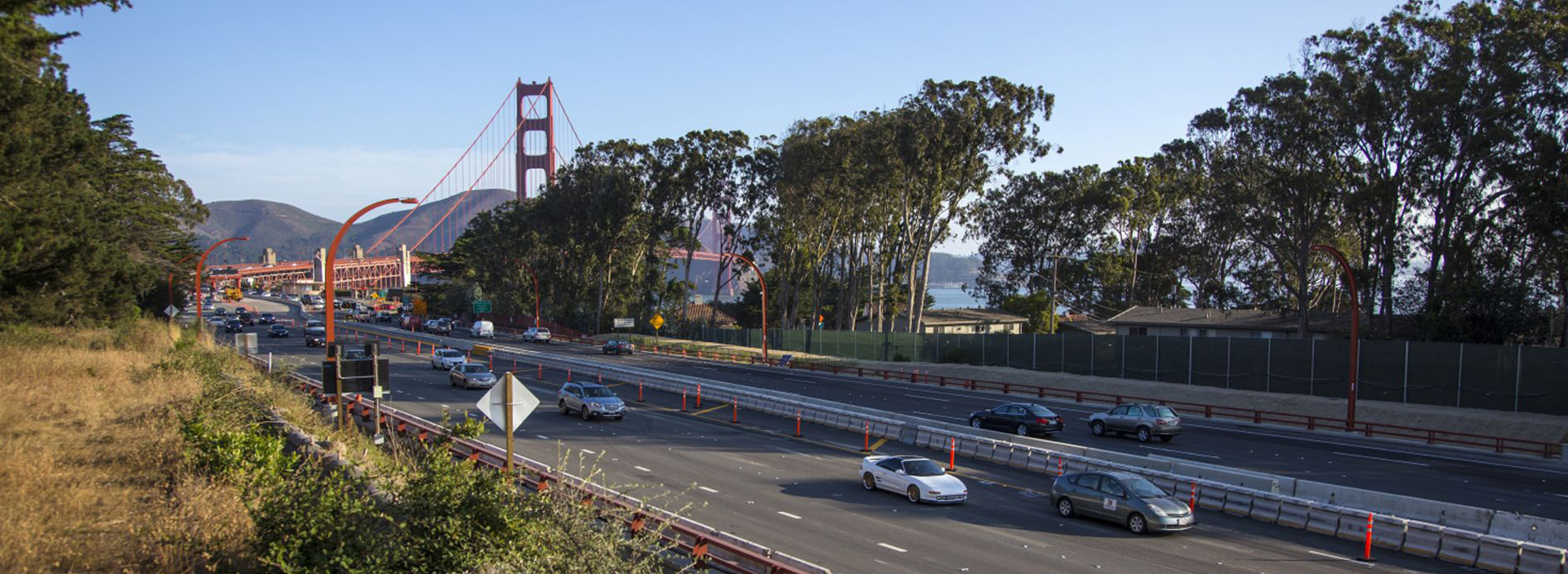
We were involved with the Presidio Parkway for 16 years in several planning, design and advisory roles on behalf of the San Francisco County Transportation Authority and the California Department of Transportation (Caltrans) beginning in 1999 as lead consultant for an environmental and design study that considered alternatives for replacing Doyle Drive. The resulting environmental impact statement and report was approved in 2008. Construction of the new Presidio Parkway started in 2009.
We initially served as the prime consultant for the environmental impact statement/report. In joint venture, we provided general engineering, final design and construction support services; and P3 contract services at a time when P3 delivery was not a common infrastructure delivery method in the U.S.
Presidio Parkway was the first P3 procurement under California’s new SBX-4 P3 law. This was a complex project with multiple federal, state and local stakeholders that required multiple technical, commercial, financial and political resources to advance the project and meet the owner’s goals and the stringent requirements of the local federal landowner. We led development of the payment mechanism and continued to play an advisory and contract oversight role.
The project team strived to create a roadway that reduced impacts to biological, cultural and natural resources; respected the project setting within a national park, the National Historic Landmark District, and the surrounding neighborhoods; met community needs; and provided a safer roadway.
Presidio Parkway has three travel lanes in each direction—two 11-foot lanes and one 12-foot lane to accommodate buses—separated by a landscaped median ranging from 16 to 41 feet. Wider lanes, the new median and continuous shoulders improve safety. Pedestrians and bicyclists also benefit from numerous opportunities that did not exist previously to cross over or under the parkway and access the shoreline.
The project won the American Roads and Transportation Builders Association P3 Project of the Year in 2012. In addition to our role as P3 advisor, we supported the successful Transportation Investment Generating Economic Recovery (TIGER) grant application, which gained the project a $46 million federal funding award.
Other project elements include new steel and concrete bridges, two cut-and-cover tunnels and an at-grade roadway with landscaped berms—all designed to withstand a high magnitude 8 earthquake without danger of collapse and/or easily repairable damage. The first phase of this project was completed under a design-bid-build procurement and the second phase was constructed under a P3 procurement (design-build-finance-operate-maintain), with the private concessionaire providing operations and maintenance services on the roadway for 30 years.