Pumped hydro schemes are widely promoted across Australia as being a necessary enabler of a reliable, sustainable and equitable energy transition. These projects are essential to support Australia’s very large and rapid development of renewable energy projects such as wind and solar, providing stability to future electrical grids dominated by intermittent, variable energy generation. Pumped hydro schemes provide grid stability by discharging hydroelectric power from water stored in an upper reservoir when the pure renewables are not generating. Water is pumped back to the upper reservoir when renewable energy is abundant.
The resurgence of interest in pumped hydropower projects in Australia creates a rapid learning curve for developers, many of whom are private entities. It also brings development risks of all types and scales for stakeholders. Because pumped hydro plants have not been constructed in Australia for decades, experience of pumped hydro development is lacking across all stakeholders, including owners, contractors, consultants, regulators and lenders. Coupled with the increasing expectations and scrutiny of environmental, social and governance (ESG) performance, the pathway to getting pumped hydro projects up and running is complex.
Developers new to the industry, and even some with experience, often base their development pathways on optimistic timelines for the critical steps leading up to financial close. The timeline is often too short to plan the delivery strategy properly and to consider the various checks and balances that other stakeholders impose on the developer. It is important that projects take the time to get the planning right and not rush the process. Failing to do so, runs the risk of cost and time overruns during project delivery.
How much geotechnical investigation is enough?
Large pumped hydro schemes will likely involve significant underground works at great depth. To mitigate the associated ground risks, it’s crucial to ensure significant investment and careful planning of the geotechnical investigation. It’s usually easier to obtain approvals for shallower geotechnical investigations – i.e. dams and reservoirs – than for deep caverns and tunnels. However, all project elements need adequate investigation, so it is a challenge to decide where to allocate investigation funds to gain the most critical knowledge.
Another issue facing Australian pumped hydro developments is the inability to fast-track geotechnical investigations due to the many steps required to obtain environmental approvals for drilling, particularly in environmentally sensitive areas. The time required to obtain approvals, complete drilling, interpret results and then refine the design shouldn’t be underestimated.
A related and common problem is not allocating sufficient time to develop an adequately informed reference design on which the environmental assessment will be based. This design needs enough flexibility to allow modification without delaying the approvals or construction, as the understanding of the likely ground, groundwater and environmental conditions improve through each phase of investigation.
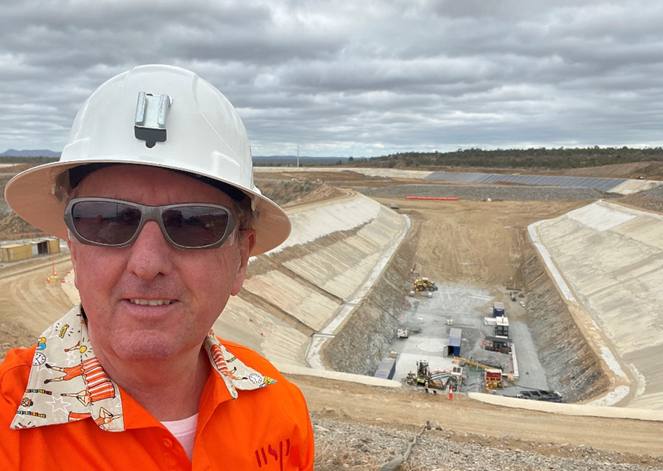
Andrew Noble in the field on a pumped hydro project.
What risks should be considered?
The track record of multidisciplinary hydropower projects shows a very high incidence of cost and time overruns. Care is needed to avoid the owner’s team assessing time and cost without benchmarking against other completed projects. Typical financial risks relevant in the current Australian market include changes in regulation, variability in foreign exchange rates, electricity market risks, delays in reaching financial close, escalating costs, and the capacity and performance of contractors.
What will lenders look for?
For a project to obtain debt funding, and for it to successfully bridge the gap between feasibility studies and financial close, the developer needs:
-
a well-considered reference design
-
early contractor involvement
-
adequately documented options
-
a clearly defined rationale for the adopted design.
It’s important that the business case adequately covers all the topics that lenders will want addressed. This includes how the total outturn cost and completion date will be controlled and managed.
Lenders care deeply about ESG performance. They are very alert to the potential for reputational damage that will result from inadequately planned and implemented projects. The Hydropower Sustainability Assessment Protocol developed by the International Hydropower Association is useful for assessing projects across a range of social, environmental, technical and economic criteria.
Lenders will typically be involved across four key stages: due diligence, the pre-financial close (‘bankable’) phase, construction and operation. Each stage brings a different focus with the lenders’ accumulated risk exposure ebbing and flowing as the project evolves.
Bringing it all together
It is important to have an overall contracting strategy in place before embarking on a feasibility study. The strategy should include costs and timelines for undertaking all steps, including key milestones such as when lenders will be engaged, and a list of the assessments that lenders will look for to satisfy themselves that the project is bankable and has no gaps.
To find out more about how WSP can support your hydropower or pumped hydro project, contact Andrew Noble, Technical Director, Hydropower & Tunnels.