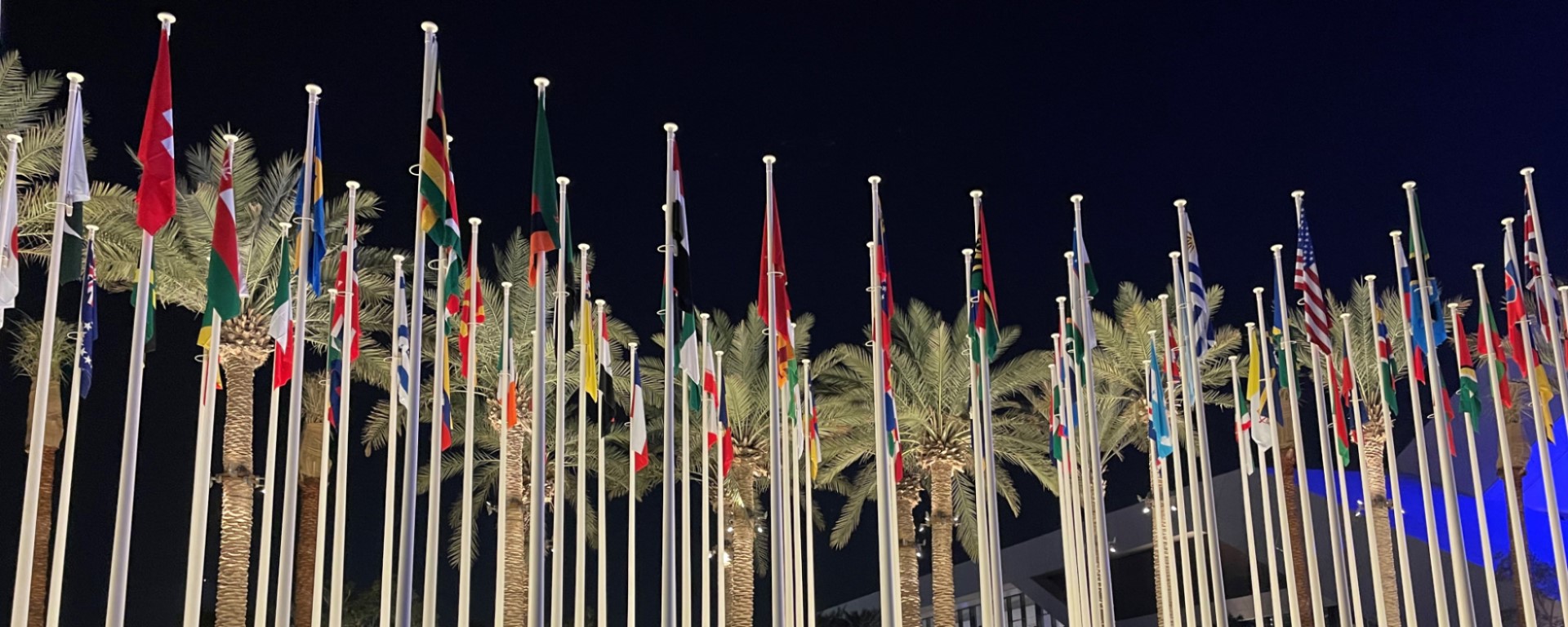
He's talking about the COP28 UN Climate Change Conference held recently in Dubai, United Arab Emirates. Cal, a 25-year-old asset management engineer, attended as part of a group representing New Zealand business travelling on passes provided by the Ministry of Foreign Affairs and Trade (MFAT).
Cal works in the transport sector at WSP. Over the past 18 months, he's taken on a leadership role within WSP in New Zealand's decarbonisation programme, tasked with guiding the business to meet its target of halving the carbon footprint of designs and advice provided to clients by 2030. He's taken several insights from COP28 back to Aotearoa's shores.
The scale of COP28 was phenomenal, he says. The conference venue was the size of downtown Auckland. 85,000 people took part, including more than 150 heads of state and government, and representatives from national delegations, civil society, business, indigenous peoples, youth, philanthropy, and international organisations.
“At any one moment there's hundreds of negotiations, presentations, events, and even spin-off conferences happening. You're only ever seeing a small sample of what's going on, so you must be strategic with planning out your time in advance.
Appropriate, timely, and resilient infrastructure
“My goal was to identify and bring home the best of global thinking relating to infrastructure decarbonisation and resilience. To achieve this, I mostly went to talks given by governments, multilateral development banks, and engineering organisations working across energy, transportation, and the built environment.”
One of Cal’s main takeaways from COP28 is that appropriate, timely, and resilient infrastructure will be the backbone of the green transition.
“For most of us, when infrastructure works well, it’s invisible and rightly so. But in reality it functions as the enabler of so much else and is needed to unlock an accelerated green transition across so many different domains,” he says.
Examples include EV charging and public transport infrastructure for decarbonising transportation and mobility, expanded energy grids to facilitate electrification of industry, and pipelines for novel energy sources.
“Investment in sustainable transportation, infrastructure, and the places where we live will enhance our ability to combat climate change while also creating a foundation for a more environmentally conscious and resilient future,” says Cal.
Nature-based solutions and blended finance
Recurring themes like equitable climate finance, strong policy signals, and innovative nature-based solutions were evident across most of the discussions at COP28.
With discussion focused on funding the economic transition to a low carbon economy, Cal says it was positive to see development and commercial banks outline how they’re supporting a blended finance approach to deploy climate-related capital globally. The numbers being cited were staggering, with about USD $2.4 trillion dollars per annum needed for the developing and emerging economies.
“People from industry and business were calling for strong, nonpartisan climate policy from governments, giving them the certainty ahead of making major investments in new plant or facilities. Climate scientists continued to stress the need for faster, deeper, and more sustained emissions reduction,” he says.
Nature-based solutions featured heavily in discussions about resilience of the built environment and ensuring that we design with a more uncertain and potentially volatile future climate in mind.
“The impacts of extreme weather events have been front-of-mind for a lot of New Zealanders in recent years. Integrating nature-based solutions into projects allows us to address the root cause of infrastructure fragility, which is critical to building a resilient Aotearoa and is why we have spun-up a nature advisory business unit within our New Zealand team.
“It was encouraging to see that the decarbonisation and wider sustainability work that we're doing here at WSP is on par with or exceeding global best practice. What I saw at COP28 is a reminder to keep going and not to take our role as designers of the built environment for granted.”
Cal says there were so many phenomenal presentations. He was especially impressed by the calibre of the Canadian, Australian, and Singaporean pavilions, and managed to catch a few world and business leaders speaking during the first week.
“I enjoyed seeing Ajay Banga, the President of the World Bank, and Fatih Birol, the Executive Director of the International Atomic Energy Agency speak about the developing world, renewable energy, and how they view the role of their organisations in addressing the climate crisis.
“I saw Hilary Clinton present on some of the work that her organisation has done to support SEWA, India’s Self-Employed Women’s Association on how they’re building the resilience of self-employed people in the face of ever-increasing extreme heat.”
Despite recent reports suggesting the world is dangerously close to eclipsing the 1.5-degree temperature threshold set out in 2015's Paris Agreement, a 'Keep 1.5 Alive' slogan was still very noticeable at the conference.
While the COP conference sometimes does get criticised, Cal says it's a forum that matters in bringing together virtually every country to collaborate on addressing climate change - the single most pressing global issue of our time.
“It was pleasing to see COP28's energy-related pledges get plenty of coverage, and no doubt that attention will soon turn to Azerbaijan’s upcoming COP29. But following the hottest year on record it's vital we learn from the best of the ideas, discussions, and case studies showcased at the COPs and start applying these to the engineering and infrastructure projects we do here at home - to help accelerate what has become ever more urgent climate action.”
More information about the high-level agreements at COP28, including a global roadmap to transition away from fossil fuels, can be found in this wrap-up presentation from WSP UK.