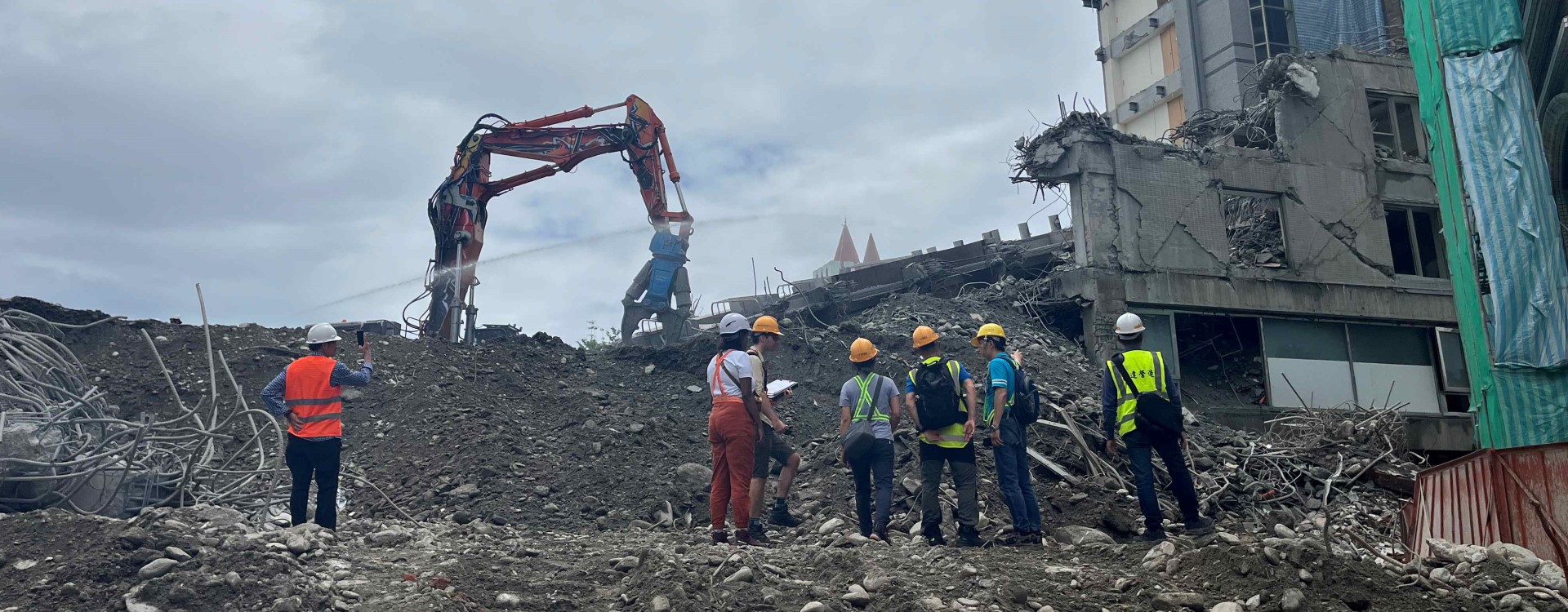
Organised by the Society for Earthquake Engineering (NZSEE) and funded by the Natural Hazards Commission (formerly EQC), the aim of the trip was to learn from the earthquake event and help improve our own earthquake engineering practice and risk reduction.
NZSEE has been organising earthquake learning trips like these for decades. The Taiwan trip was also attended by representatives from the Universities of Canterbury and Auckland, Ministry of Justice, Ministry of Business, Innovation and Employment, and Richard Mowll Consulting.
Julian and Doug say Taiwan and New Zealand are bedfellows when it comes to seismic risk. Both straddle plate boundaries on the Ring of Fire. In both countries, there are towns and cities built on loose sediment prone to liquefaction.
Despite the intensity of the quake, damage wasn’t immediately evident when the travelling delegation first arrived on the streets of Hualien City.
“The Taiwanese move efficiently with rapid building assessments and clearing damage. We’d be walking around and see asphalt where there’d been a 10-story building only a few weeks earlier. They tend to get things done quickly, pulling damaged buildings down without construction contracts, for example. The county council organises that,” says Doug.
April’s Hualien quake was Taiwan’s largest since a 7.3ML magnitude shake hit the town of Jiji in 1999, causing over 2,400 deaths and destroying almost 52,000 buildings. The Jiji event was a pivotal moment for Taiwanese earthquake engineering, with the government improving building codes, and bolstering emergency response capabilities.
The pair says the group is still crystallizing lessons from the Hualien trip, but a key area being looked at is emergency management relationships between agencies.
“Their information systems aren’t necessarily any more advanced than ours, but they are well integrated between agencies and the country as a whole is well-rehearsed in disaster preparedness - so that’s something for New Zealand to consider.”
Julian says another lesson to be learned from the Hualien quake is that building strengthening works in saving lives and limiting damage. So too is the importance of construction monitoring and quality control, which needs to be as good as building design standards.
“Taiwan’s building strengthening is quite simple and efficient. Simple retrofits that addressed basic structural deficiencies seemed to work well. Recently strengthened buildings performed well against a similar shaking event in the Hualien area in 2018. Those that weren’t since the last event, collapsed or performed badly.”
In Hualien City, the group was joined by people from California-based Earthquake Engineering Research Institute (EERI) and Taiwan’s National Center for Research on Earthquake Engineering (NCREE).
They collected data from damaged buildings and travelled to Taroko National Park where most of the quake’s victims had been killed by rockfalls. Meetings were had with building and government officials to learn about response and recovery.
Doug says the terrain in Taiwan’s national parks is like New Zealand’s Southern Alps and West Coast, with roads at the bottom of sheer cliffs and many walking tracks through the mountains. In a large shake or typhoon, rockfalls and landslides can tumble down from hundreds or thousands of metres above, cutting off critical transport routes.
“They’ve learned through hard experience over the last 25+ years what they need to do to make their roads and cities more resilient. They’re always looking to improve and embed lessons for next time in terms of rockfall protection, building standards, land use plans, emergency response and recovery, and more.”
Julian says Taiwan has a similar natural hazards insurance scheme to New Zealand but theirs is a bit different from NZ’s Natural Hazards Commission.
“There, it’s insurance you optionally pay for. Here, it’s a levy. They’re quite swift to respond and settle claims under their insurance scheme as they only cover total loss, so the testing is simpler. There were around 11 settlements for collapsed or written-off buildings in the Hualien event.
“That’s one of the things they can look to us for - how they improve their coverage, because in New Zealand we have a near universal level of coverage by the Natural Hazards Commission.”
In the coming months, Julian and Doug will be documenting their trip insights and distributing these via papers, reports, and presentations.
Lessons learned from the Hualien trip and future NZSEE earthquake learning trips will ultimately find their way into earthquake engineering practice, they say.
“Within our travelling group were people potentially involved in future NZ standards developments and revisions, so having this experience to draw on has been invaluable.”