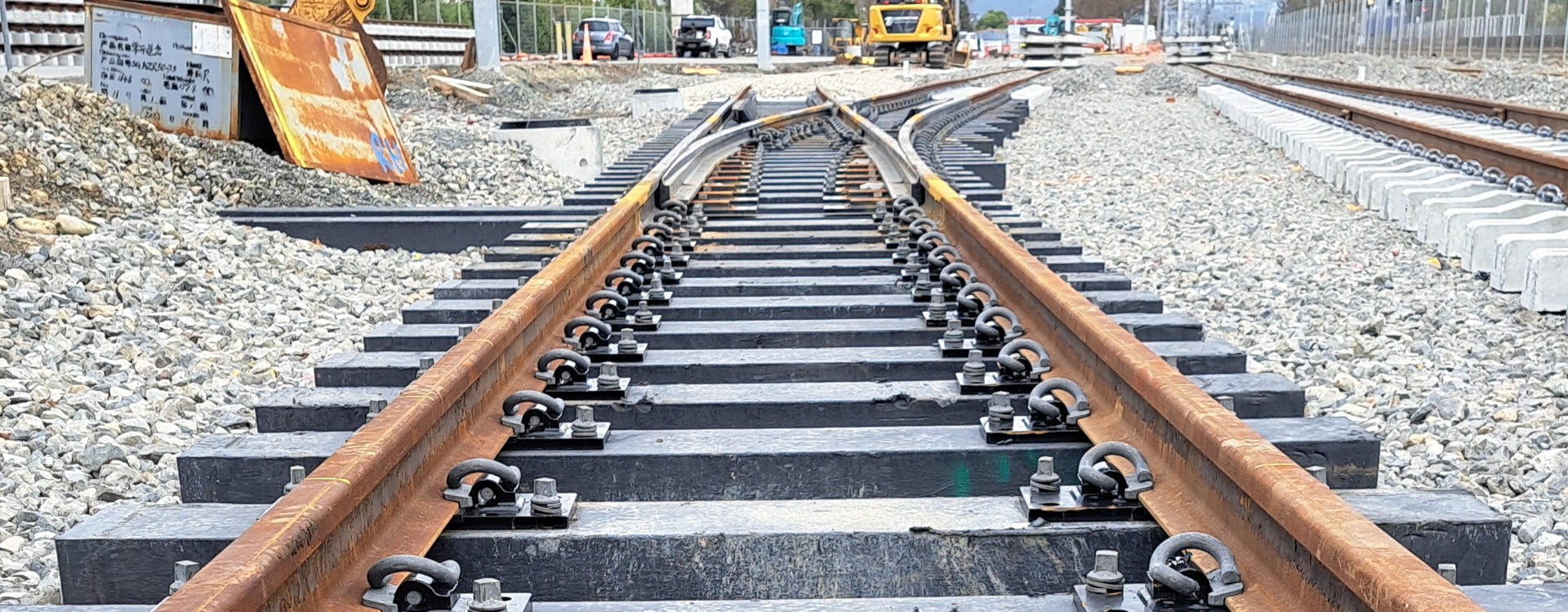
The yard, used to store KiwiRail’s fully electric Matangi trains, needed more than just new track. The main driver for the upgrade was to allow for more robust storage and better accessibility through the Wellington network.
Wider clearances between sidings were also introduced to improve safety for rail operators, and the entire layout was redesigned - four sidings in total, with two realigned.
The job involved heavy machinery and even heavier materials - including hundreds of cubic metres of crushed stone, concrete sleepers, and kilometres of steel rails.
“It was a difficult site to work on - already developed land with a narrow corridor, poor ground conditions, and little information about what was buried underground,” says WSP principal engineer for civil infrastructure Tom Jones.
“A lot of the work was underground, getting the formation right, installing subsoil drainage, and making sure everything was safe and compliant.”
WSP looked after surveying, geotechnical and contaminated land investigations, and preliminary and detailed civil and track design.
Five ten-metre-deep boreholes were drilled to assess soil behaviour, and contamination testing was carried out. A new drainage network was installed, including soak pits and water treatment chambers fitted with ‘jellyfish’ filters - compact devices that trap sediment and pollutants.
“The site was tight and complex, with lots of moving parts across rail, civil, and structural works that had to be carefully coordinated. Everything had to fit together smoothly to make the project work,” says WSP service line leader for transport design Jaco Vorster.
“We had a constrained budget and deadline, and existing infrastructure like overhead lines and signaling huts being built before we’d finished design. Getting it over the line while maintaining quality was a real team effort.”
For WSP’s surveying team, it was a complex project in terms of coordination - making sure every element of the design aligned properly across the site.
Construction was carried out by Wellington-based Action Civil. From preliminary design to construction start, the project took one year. It was delivered on time, with design and build completed by 30 June.
WSP senior project manager for rail Nikhil Nair, who led this year-long project, says delivering the yard upgrade was a proud moment for the team.
“Through meticulous engineering, close collaboration with KiwiRail, and a sharp focus on compliance, we not only enhanced safety and efficiency but have helped lay a solid foundation for future rail growth in the region.”
The work was familiar territory for WSP, having recently worked on the Port Chalmers rail pad replacement project, Dunedin’s Hillside yard, and the West yard in Wellington. It’s part of a wider KiwiRail programme to improve rail yards across the Wellington region.