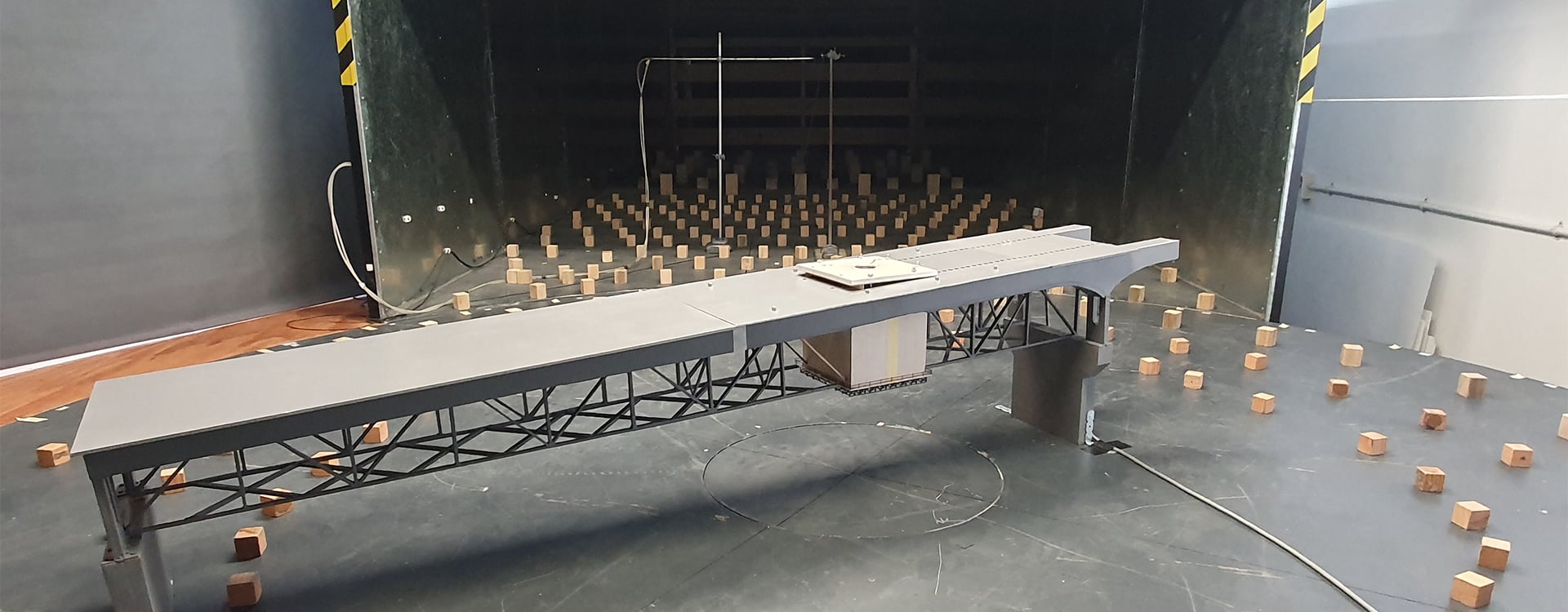
As part of ongoing maintenance by the Auckland System Management Alliance, steel structures like the Harbour Bridge need to be protected from corrosion using specialised coatings. Removing the old paint must be done carefully to prevent flakes from polluting Waitematā Harbour - hence the need for a fully enclosed scaffold.
Hanging a scaffold beneath a bridge may seem straightforward, but it’s anything but. Structural engineers from Beca needed to understand exactly how wind would affect the scaffold and bridge. That’s when WSP entered the picture.
“In the first half of last year, we ran detailed desktop calculations and did a wind tunnel test. We took a 1/100 scale model section of the bridge and scaffolding, complete with 3D-printed parts, and spun it through 360 degrees of wind,” says WSP principal research engineer Nick Locke.
WSP’s wind tunnel is housed in Petone, Wellington – just a stone’s throw from shops and seafront. It resembles a gigantic air-conditioning unit – but one that packs a serious punch.
The key concern was whether the bridge could handle the combined weight of traffic, the bridge itself, and the scaffolding during a worst-case wind scenario.
“We were interested in the maximum loads the hanging structure could be subjected to, which was about 46 metres a second at 40 metres above the ground. That's the wind speed you'd expect to occur in a once in 2,500-year storm, which is a scenario well above the wind speed threshold at which the bridge would be closed to traffic” says Nick.
Nick and his team also ran a pressure study to understand how wind flowed around and under the scaffold. They found it behaved like an upside-down house, with air flowing beneath it and creating suction that pulled down on the bridge - adding to its gravity loading.
“Wind tunnel testing was crucial for this project because it helped the engineers understand exactly how wind would interact with the scaffold and the bridge,” says Nick.
“It wasn’t just about numbers. It was about understanding the real-world forces at play. The way the wind flowed under the scaffold, creating that downward pull, made it a really interesting and challenging problem to solve.”
Add it all up, and when the hanging scaffold is finally put in place, the engineers and maintenance crews can be confident it’s built to handle the winds Mother Nature is expected to throw at it.