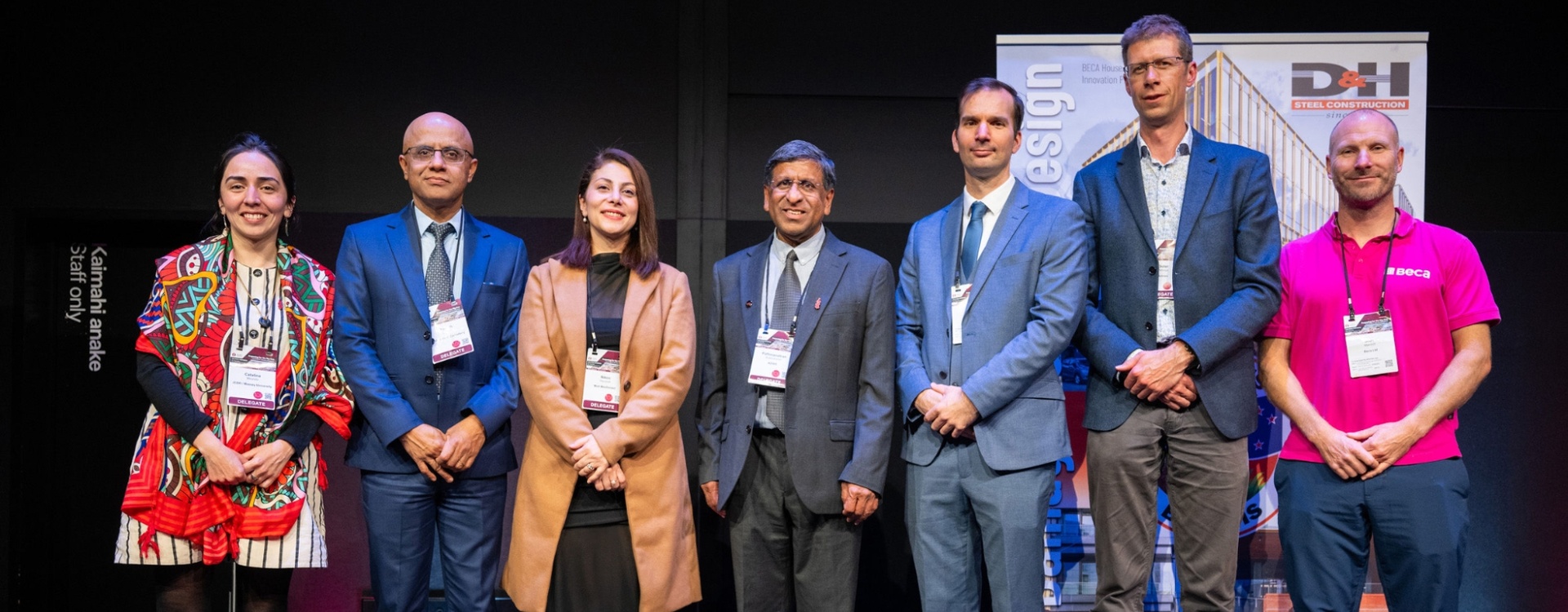
Established six decades ago, the 1,200-strong membership-based society advances the science and practice of earthquake engineering in Aotearoa New Zealand. It has built a strong international reputation, with many design approaches now used globally first pioneered here in New Zealand and developed through the Society.
As the sector’s umbrella body, NZSEE spans the full spectrum of earthquake engineering and related fields, from seismology and structural and geotechnical engineering to social sciences and emergency management.
Julian and Brabha say great strides have been made in past decades to preserve life during earthquakes, but more can, and is, being done, especially in this new era of emerging technologies.
“We’re continuing to evolve, and we know far more today than we did 20 years ago, but it remains a work in progress, and there’s always room to improve. Historically, seismic design focused on preventing collapse and saving lives, with considerable damage to the building. Today, expectations are higher. There’s a growing emphasis on low-damage design, where buildings can be quickly reoccupied after an earthquake. That’s the transition we’re in,” says Julian.
Recent legislative developments have seen a new earthquake-prone buildings regime proposed. Because it affects how earthquake-risk buildings are identified and managed, NZSEE has provided feedback on that Bill along with Engineering New Zealand and other Societies. In recent years, NZSEE has contributed to the National Seismic Hazard Model and updates to seismic design standards, codes, and assessment guidelines.
NZSEE is also part of the Steering Group for BRiDGE (Building Resilience in Design Guidance for Engineering), a cross-agency programme led by Engineering New Zealand, funded by NHC, MBIE and NZTA, and led by WSP’s Paul Campbell. It commissions projects to develop guidance for engineering practice.
The Society supports the profession through guidance, technical events and knowledge-sharing, including an annual conference and training courses.
Julian and Brabha say WSP’s backing has enabled them to contribute meaningfully to the Society’s work and has helped highlight WSP as a leading firm in earthquake resilience.
“I’d also like to acknowledge Brabha for the significant time and effort he’s put into leading the Society in his time as President and thank WSP for its ongoing support for both of us,” adds Julian.
More information about NZSEE can be found here.