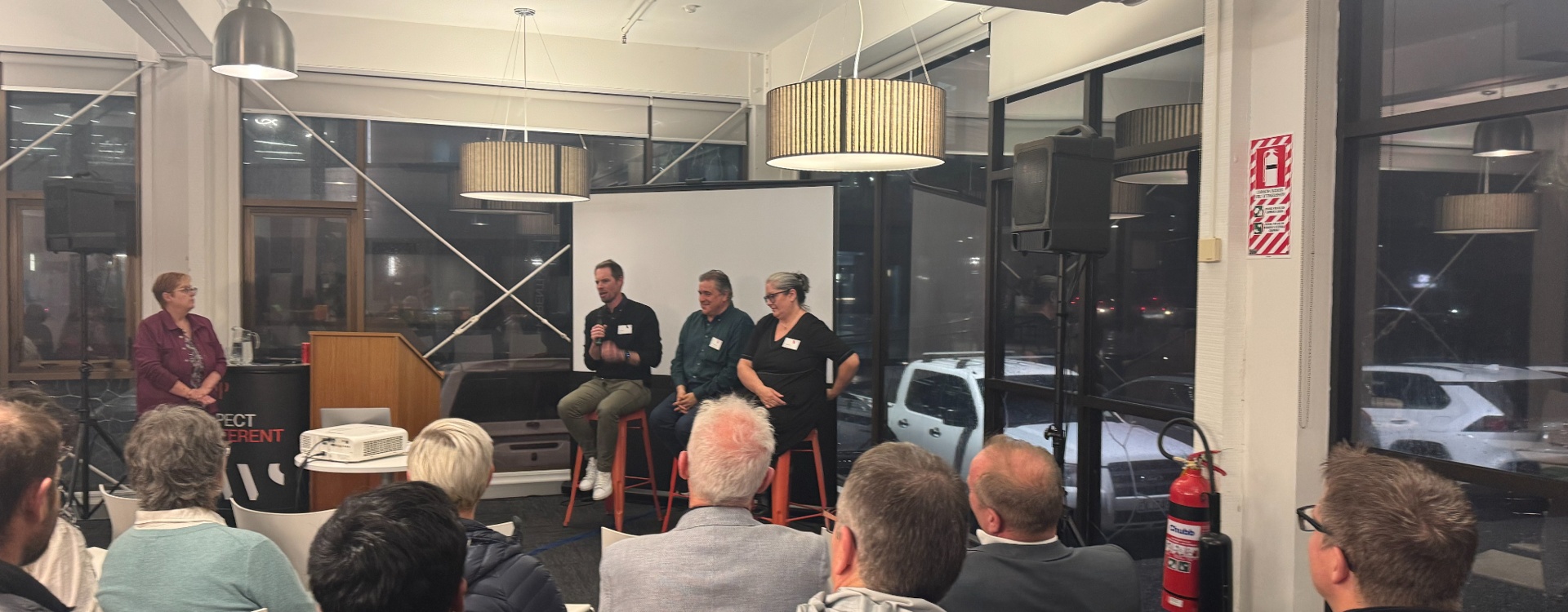
Chief Executive of 3R Group Adele Rose gave an update on Aotearoa New Zealand’s first regulated product stewardship scheme for end-of-life-tyres.
Tyrewise has been running for over two years. It recently celebrated the collection of over seven million tyres.
Designed and developed by 3R Group, Tyrewise manages a network of collection points around the country and promotes different ways of re-using old tyres. WSP sits on a Tyrewise technical advisory group providing expert advice.
One of the more innovative examples of re-use has been contractor Fulton Hogan re-sealing a road using crumb rubber from recycled end-of-life tyres in chip seal binder.
About half of the sixty thousand tonnes of waste tyres collected annually in New Zealand go to Golden Bay Cement, which uses them as a source of fuel in its cement manufacturing. Old tyres are also being used to create moulded rubber products.
While unable to attend the Petone event, Team Leader for Pavement Engineering at the NZ Transport Agency Dr Dave Alabaster spoke at the Auckland event about asphalt binders made by adding epoxy resin to bitumen.
Epoxy resin creates a stronger, longer‑lasting road surface. Now well-proven across New Zealand, the technology helps cut carbon emissions over the life of a road and helps avoid repeat re-surfacing.
Next up was Auckland Council Head of Engineering and Technical Services Branko Veljanovski, who talked about the use of recycled aggregate in civil engineering.
Aggregates are the non-renewable raw material used in construction – typically gravel, crushed stone, and sand. Demand for aggregates has risen in recent years, due to infrastructure, housing and roading.
Auckland Council now officially approves the use of Recycled Concrete Aggregate (RCA) in infrastructure and construction projects under a specification it worked on with a range of experts from WSP.
Branko pointed to examples where recycled aggregate from demolition waste has been used in Auckland, including for surfacing at Normanton Reserve, Glenfield, and for piping at Hakanoa Street, Grey Lynn.
WSP’s Matt Sharp followed, speaking about the development of a 100% pine tree-based alternative for roading bitumen.
Led by WSP and funded by the Ministry of Business Innovation and Employment’s Endeavour Fund, early results are promising, and the potential could be significant.
Matt says the world-first innovation offers a potential alternative to imported fossil‑fuel bitumen.
In the lab, the pine-based material performs similarly to conventional bitumen. While field testing and economic assessments are yet to be done, it could be a gamechanger for more sustainable road design and surfacing.
More information about some of the innovative research solutions being developed at WSP can be found here.