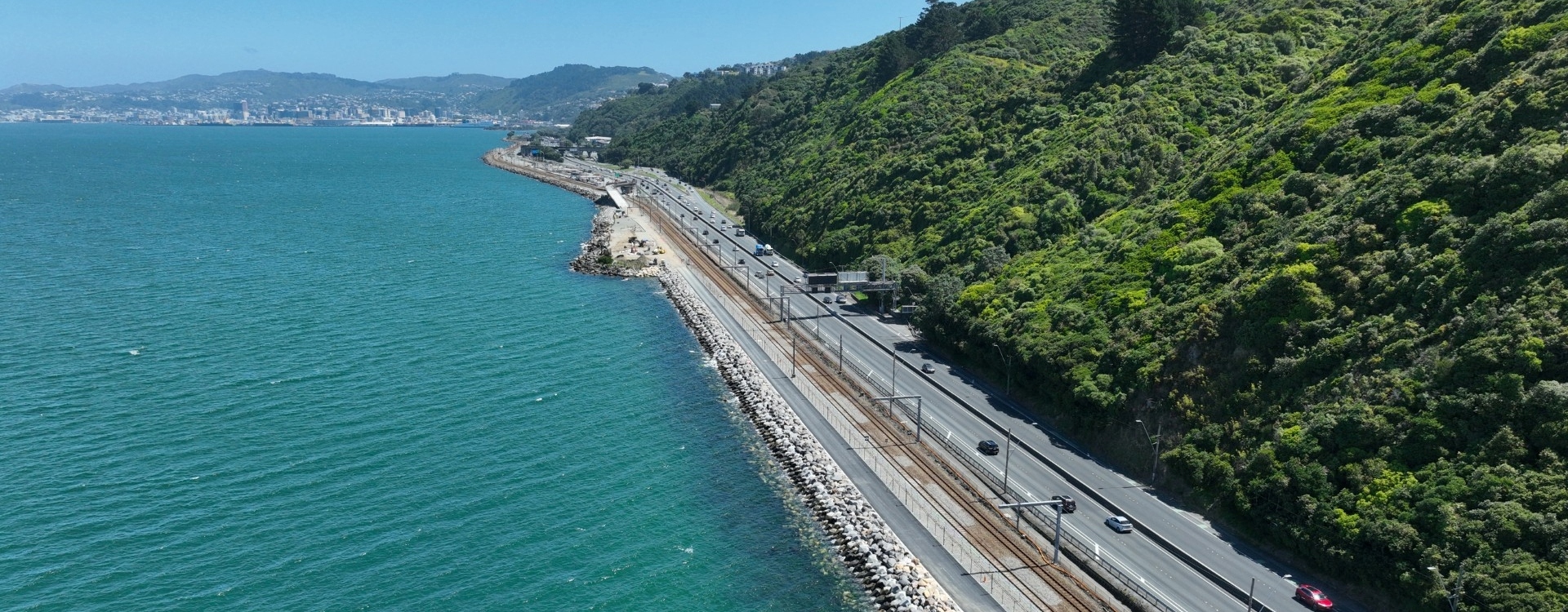
WSP’s testing has happened a stone’s throw from the project site – at its Petone research and innovation facility.
At regular intervals, cylindrical specimens of wet concrete used on the project were delivered to WSP technicians. On average, samples came from every third truck of concrete.
After 28 and 56 days’ conditioning in a purpose-built fog room, specialist equipment was used to compress the samples until they broke. They all had to meet certain standards of rated strength, ranging from twenty-five to fifty megapascals.
WSP has tested the project’s bridge components, kerbing, and interlocking XBloc® units that make up parts of the seawall.
WSP team leader for asset performance Jonty Glen says it’s pleasingly unusual to be testing samples from a major civil engineering job located right on WSP’s doorstep. He can see Te Ara Tupua being built from his desk in Petone.
Concrete testing isn’t a visible part of the project, but it’s important work. As an International Accreditation New Zealand laboratory, WSP’s testing was part of the project's quality control.
Jonty says strong samples give assurance that the concrete used is up to standard and will cope with all that the weather and waves can throw at it.
Ultimately, he says, the testing aimed to answer a simple question: is the concrete being used fit for purpose today - and will it still be fit for purpose decades from now?
While they work nationwide, Te Ara Tupua is the latest in the long line of local projects WSP’s concrete testing team is involved in – another local path is the Eastern Bays shared pathway, and flood protection and transport projects within Te Wai Takamori o Te Awa Kairangi.
Te Ara Tupua is being delivered by Tonkin + Taylor, Downer NZ and HEB Construction on behalf of NZ Transport Agency Waka Kotahi and its iwi mana whenua partners Taranaki Whānui ki te Upoko o te Ika and Ngāti Toa Rangatira.