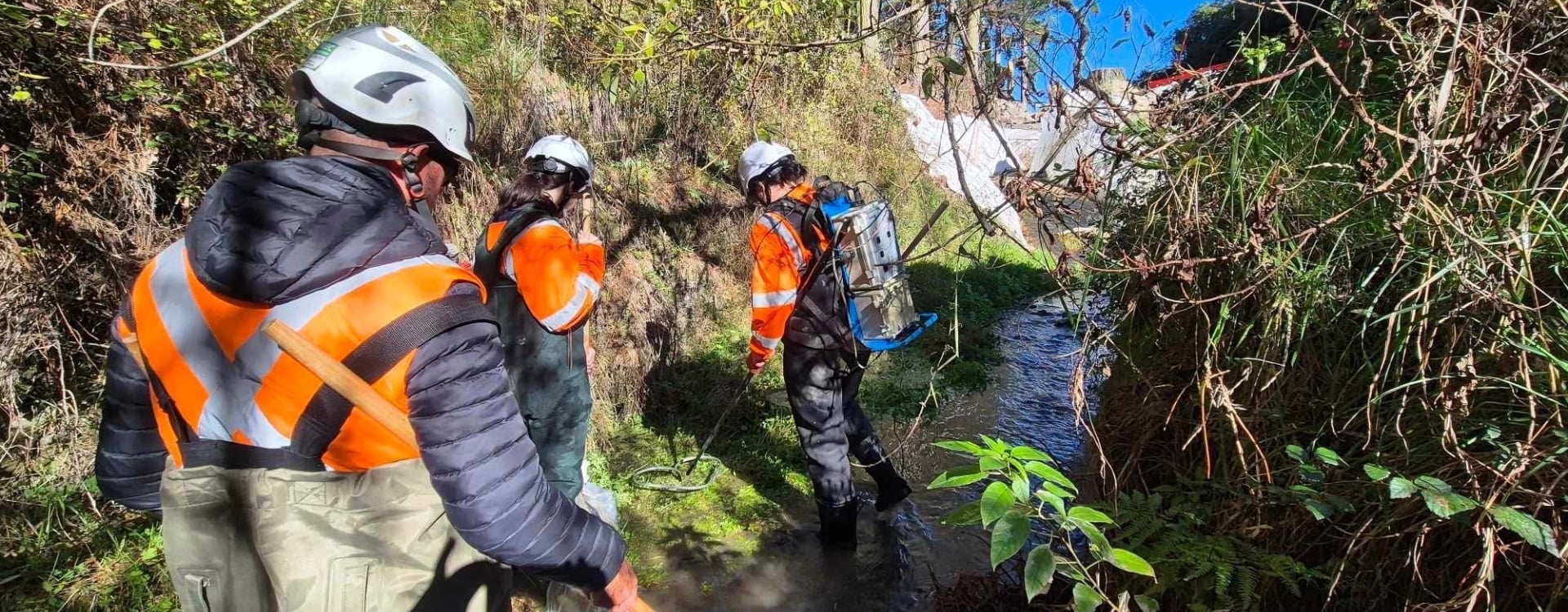
When we chat with team leader for ecology and environmental science Emily Frost, she’s fresh from the field, still in a high-vis vest. She leads a team of 6 in Napier and is part of a 33-strong team of WSP ecologists nationwide.
Ecology is an outdoors job by nature. On any given day, team members can be found at waterways, coastlines, mountains, forests, and grasslands the length and breadth of the country.
Involving ecologists on construction projects is important for a simple reason – construction can harm small species, many of which are already threatened or at risk.
WSP’s ecologists are driven by a purpose to help reduce harm to native species and the habitats they rely on.
The Napier team alone has had its hands full with recovery projects following Cyclone Gabrielle which tore through the East Coast in February 2023. Since last year, they have worked on 160 ecological projects, most of them involving fish salvage and fish passage – work Emily describes as the team's bread and butter.
One of the Napier team's bigger recent projects has been ecological assessments of five urban streams that run through Havelock North.
The team walked the length of the streams recording structural obstacles that prevent fish from travelling upstream to complete their lifecycles, noting any stormwater discharges, and assessing overall ecological health.
They found 150 barriers to fish passage across the five streams. Poor water quality and a lack of riparian, or stream-side planting, were also significant issues.
Work is now underway with the local Council to monitor water quality, plant stream margins, and prioritise which fish passage barriers should be fixed first.
One of the post-cyclone Transport Recovery East Coast (TREC) projects the team worked on was a bridge washout replacement in an ecologically sensitive wetland area home to native lizards, birds, and fish.
Working with mana whenua, they supported a planting programme, carried out lizard trapping, and designed a bird deterrence plan to keep nesting species away from construction activity.
They also did a lot of fishing - but not in the way you might expect - instead, capturing thousands of fish alive and relocating them.
Freshwater fish capture is a big part of WSP ecologists’ work. Techniques such as netting and electric fishing are used to safely capture and relocate species such as tuna (eel), trout, black flounder, and kōura (freshwater crayfish) - especially around bridges and culverts.
Then there are the penguins. On a coastal protection rock wall project at Tokomaru Bay in Gisborne, WSP ecologists checked for penguin burrows and sub-tidal invertebrate species such as crab and crayfish. Some species were relocated to keep them out of harm's way before construction began.
Elsewhere, WSP’s ecologists have identified 'penguin highways' and colonies at planned works for Granity Seawall on the West Coast of the South Island.
Community engagement is a feature of the ecology team’s work, including involving local tamariki (children) in fieldwork.
It's not unusual for WSP ecologists to don full body hazard suits and assess the ecological impact of contaminated land. In one example, at Pukapuka Inlet near Auckland’s Mahurangi Harbour, the team assessed an area affected by asbestos linked to historic oyster farming operations from the 1980s and 1990s.
In a recent development, some members of WSP's ecology team have just been qualified through the Department of Conservation to be marine mammal observers. This training will soon be used on upcoming projects in Coromandel and Picton.
Observing marine mammals is important when piling is carried out in water. Observers help ensure buffer zones are maintained so underwater construction noise does not harm whales, dolphins, seals or penguins.
For the team, one of the most rewarding parts of the job is catching and relocating species that, otherwise, might have perished in construction works. The variety of the work is also a highlight, along with engaging with communities, working alongside Māori kaitiaki (guardians), and getting up close to taonga species vital to Aotearoa’s biodiversity.
More information about WSP's ecological services can be found here.