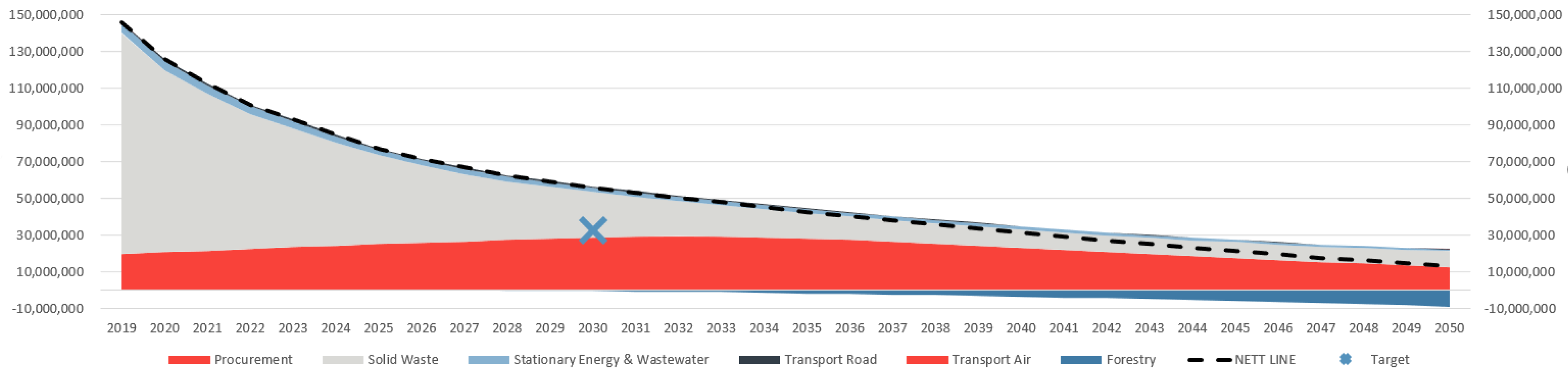
Comparing these potential pathways showed the financial cost of each pathway and the ability of each to achieve NPDC’s emissions reduction targets. NPDC decision makers gained clarity over which investments should be prioritised for upcoming budgets and became confident in progress toward the council’s emissions reduction target.
DECARBONISATION PATHWAYS
CLIENT/COMMUNITY BENEFITS
New Plymouth’s community emissions profile saw a total of gross 1,776,478 tCO2e produced in 2018. Without actions implemented by NPDC, WSP’s findings showed that the community’s emissions would not reduce fast enough, falling short of council targets. The project identified 8 actions already committed to the LTP and recommended a further 26 actions that would reduce the community’s emissions. These actions included (but are not limited to):
- Forestry and additional reserve’s planting
- Sustainable council procurement, including decarbonised infrastructure delivery
- Transport mode shift infrastructure
- Improvements to the collection and destruction efficiency at the Colson Road Landfill
- Upgrading the thermal dryer in a WWTP
- Replacing the boilers at the aquatic centre with low temperature heat pumps
These actions support equitable solutions and broader outcomes for the community, including; improved public health and wellbeing, accessibility, restoring nature and biodiversity and building a resilient economy.
KEY FACTS
- A total of gross 1,776,478 tCO2e produced in 2018
- The project identified 8 actions already committed to the LTP
- WSP recommended a further 26 actions that would reduce the community’s emissions
SERVICES PROVIDED
- EV charging infrastructure
- EV bus networks
- Active modes and behavior change
- Stationary energy
- Building energy efficiency
- Wastewater treatment emissions
- Waste and landfills
- Land use planning
- Forestry, offsetting and the Emissions Trading Scheme
- Advisory services