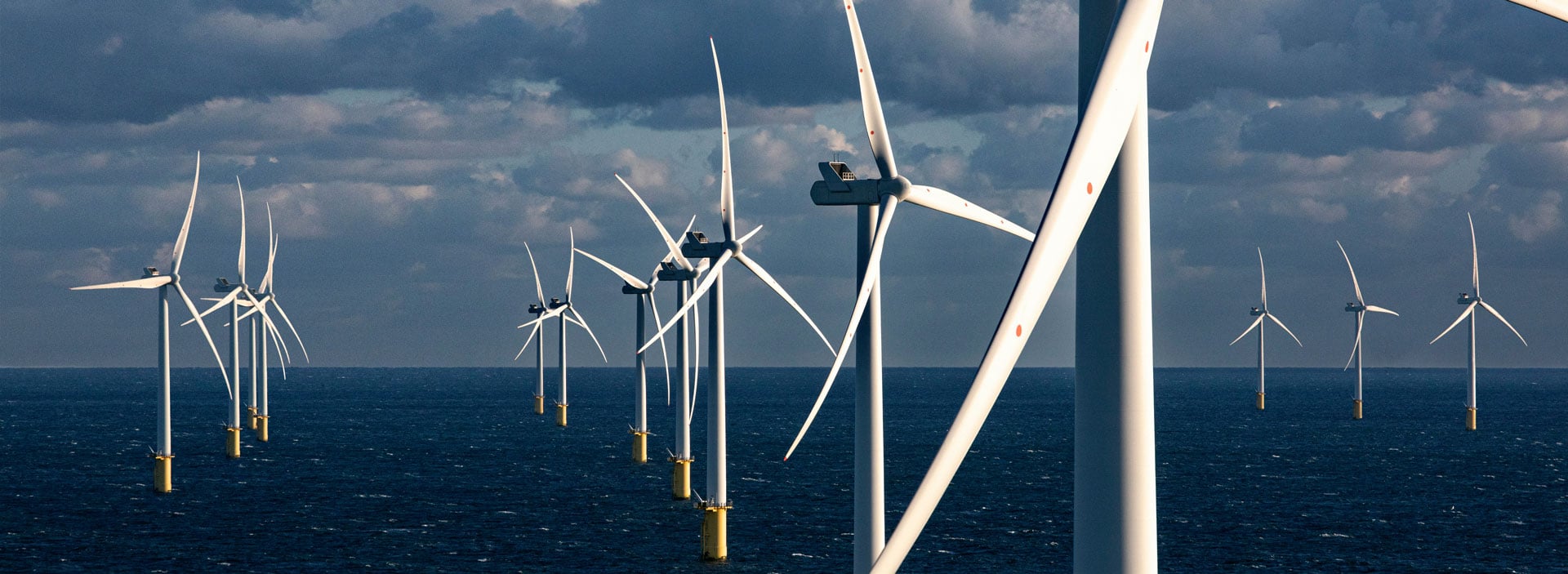
Some of our specialists recently sat down with leaders in government, planning, law and industry – Mike Young, EnergyCo; Emily Scivetti, Oceanex, and Kate Dean, KWM – to discuss some of the challenges facing offshore wind projects in Australia.
In this article, Cameron Buckley, Director of Renewables, and Alex McDonald, National Technical Director – Approvals, share their reflections on five key factors arising from the discussion that will be vital to successfully establishing an Australian offshore wind industry.
1. Policy and legislative ambition, certainty and coordination
Australia’s state and federal governments recognise that a step change will be needed in generation capacity to achieve net zero targets and to support emerging industries such as green steel and green hydrogen. Recent state and federal government expressions of support for a future offshore wind industry confirm that offshore wind will have a significant role to play in the longer term as thermal generation retires, and that there is appetite and impetus to move the industry forward. But there’s still a long way to go.
Public consultation has already commenced for the first proposed offshore wind zone in Gippsland, Victoria. The Hon. Chris Bowen has also announced that the next offshore wind zones expected are off the coasts of the NSW Hunter and Illawarra regions, near Portland in Western Victoria, in Bass Strait between Victoria and Tasmania, and off Perth and Bunbury in Western Australia. Consultation relating to declaring these zones as suitable for offshore wind developments will be conducted over the next 18 months.
Alex says, “Once these areas are officially declared and feasibility licences are granted, developers will be allowed to investigate the areas and begin planning their projects and developing management plans.
For interested developers, this process can’t come soon enough. There is significant investor interest in the offshore wind sector in Australia, but to give confidence to investors, clear signals are needed from government about the policy and legislative frameworks governing the development of wind projects offshore, and the targets and licences for the industry.”
An extra complexity is that while the projects will usually be situated in Commonwealth waters, and therefore will be under Commonwealth legislation, state governments will need to mirror this legislation where projects will cross into state jurisdictions for onshore connection to the grid, with transmission cables crossing public or private land.
“Offshore wind farms are large-scale projects, and there are significant hurdles to getting all the supporting infrastructure in place,” says Alex.
“For these projects to be cost-effective and timely, we’ll need to streamline processes and requirements so that planning and approvals can be coordinated and efficient. Speed will be necessary for our emerging industry to remain competitive in the global market.”
2. Collaboration
Alex argues that collaboration will be needed beyond the level of individual projects.
“To maximise the sector’s potential and mitigate risks, there will need to be ongoing collaboration between governments and the emerging industry,” says Alex.
“Our panellists agreed that it would be advantageous to lift our thinking above the level of individual projects and adopt a collaborative approach to the new industry as a whole – perhaps through developing a peak industry group that can help to facilitate and streamline discussions with governments and other stakeholders.”
Cameron Buckley says there’s much that the emerging offshore wind industry can learn from the international offshore wind industry, which is far further progressed.
“WSP is leveraging its international offshore wind experience in the UK, US and Taiwan for the benefit of Australian clients, including developers, government agencies and transmissions operators,” says Cameron.
“One example of this is WSP’s work for the New York State Energy Research and Development Agency (NYSERDA), where WSP undertook constraint mapping for offshore wind export cables, to allow the Agency to coordinate connection routes for multiple projects – in pursuit of New York state’s target of 9 GW of offshore wind by 2035. A similar coordination approach may have benefits in Australia where there are multiple projects potentially sharing scarce landfall locations, onshore transmission routes or connection points.”
3. Supply chains and skills
Offshore wind offers potential opportunities for new jobs and new industries, particularly in regional areas and in locations where workers may be displaced from the coal power industry, but Alex argues that opportunities need to be communicated clearly.
“These communities are likely to be concerned about job losses, so the offshore wind industry can play a valuable role in facilitating the transition and the upskilling and retraining needed. Clear messaging about the benefits of the transition to an emerging industry with new, ongoing job prospects will be important. At the same time, we must not forget the skills base that already exists locally in the oil and gas sector.
“Government can help to identify and activate regional job opportunities by working with industry and providing the clear investment signals needed to prepare business cases,” he says.
In Cameron’s view, the industry needs to think now about where components will be fabricated, whether the right people are available to fill the many different roles involved in construction, and how to attract the international supply chain.
“Given the scale of the opportunity and the major logistical and supply chain demands, a just-in-time approach will not lead to optimal outcomes,” he says.
“The emerging industry will need to attract global investors and supply chains, while at the same time balancing the incremental costs that local content mandates are likely to impose. The optimal outcome will be specific to the Australian context, but again, insights can be gained from the experience of WSP and the offshore wind industry in other locations like the US, where offshore wind legislation is driving substantial local manufacturing.”
4. Transmission route planning and grid connection
While achieving grid connection in areas of poor system strength and high congestion has been a major challenge for many onshore wind farm developments, the Rewiring the Nation program, with its sizeable government investment in renewable energy zones, presents an opportunity to make grid connection less of a roadblock for offshore wind.
Some of the designated offshore wind zones are close to existing energy facilities and industrial hubs, where the transmission network is already strong and there may not be as much need for significant investment in grid augmentation. Particularly in areas where coal power stations are slated for closure, such as in the Hunter and Gippsland regions, the new offshore wind developments may be able to make use of existing network infrastructure and transmission capacity that is freed up by coal closures.
“Nevertheless,” says Alex. “Grid connection and transmission must be considered as early as possible in the planning process, especially in terms of impacts on other users and local communities.
“It is also important to ensure that enough time is allocated to the planning, assessment, consultation and construction of the onshore connection, as the onshore components will take time to resolve and should not be rushed. The route selection for transmission infrastructure, whether it will be above or below ground, will require strong engagement with the local community and landholders.”
5. Social and environmental licence
Building social licence and managing environmental impacts are critical to the success of any renewable energy project. For offshore wind, new conversations will be needed with communities, First Nations peoples, recreational and commercial fishing industries, ports and shipping, and the many other stakeholders who may be affected by offshore wind developments.
Alex says that proponents need to build trust by engaging early, consistently and transparently – and by seeking to understand the community’s values and what is important to them.
“Our panellists’ experience was that communities are interested, curious, open-minded and generally positive about offshore wind. However, while social licence may be somewhat easier to achieve than for onshore wind projects, there will still be significant concerns about viewsheds and about any disturbance to beaches or other valued coastal areas or to lifestyles,” he says.
“Site location and visual impact assessments will need to be undertaken early to provide reassurance to locals.
“It will be helpful for proponents to offer communities justification in simple terms of why they are building an offshore wind farm, why it is important, why this technology and design is the right choice, and how it fits into a vision for a fair and just energy transition.
“Communities are more likely to accept a development if they fully understand the local and regional job opportunities, infrastructure benefits, and economic gains. In the case of offshore wind, many jobs will be created during construction but there will also be many ongoing, intergenerational jobs in operation and maintenance and other supporting activities.”
Communities are likely to be concerned about environmental impacts on birds, whales, dolphins and other marine life. Proponents will need to assess the relevant impacts and propose avoidance, management, mitigation or offset measures that satisfy the requirements of the Environment Protection and Biodiversity Conservation Act 1999. Alex also notes that while the energy generated from offshore wind is renewable, it is important to consider whole-of-life sustainability and decarbonisation all the way through the supply chain to maximise the benefits for a net zero future.
Cameron is optimistic about the offshore wind industry’s prospects in Australia.
“If we take a considered approach to the five success factors identified here, and work closely with communities to maintain their support, we’ll have a chance to build an exciting new industry that can meaningfully contribute to decarbonising the National Electricity Market while also providing new jobs,” he says.
“At WSP, we’re looking forward to drawing on our local capacity and our extensive experience of offshore wind around the world to support this very significant phase in Australia’s renewable energy journey and our vison for a fair and just energy transition.”
If you have any questions, or would like to find out more, please contact us.
To stay up to date with our latest information, publications, videos and posts, please subscribe to our news, follow us on LinkedIn or visit wsp.com/au