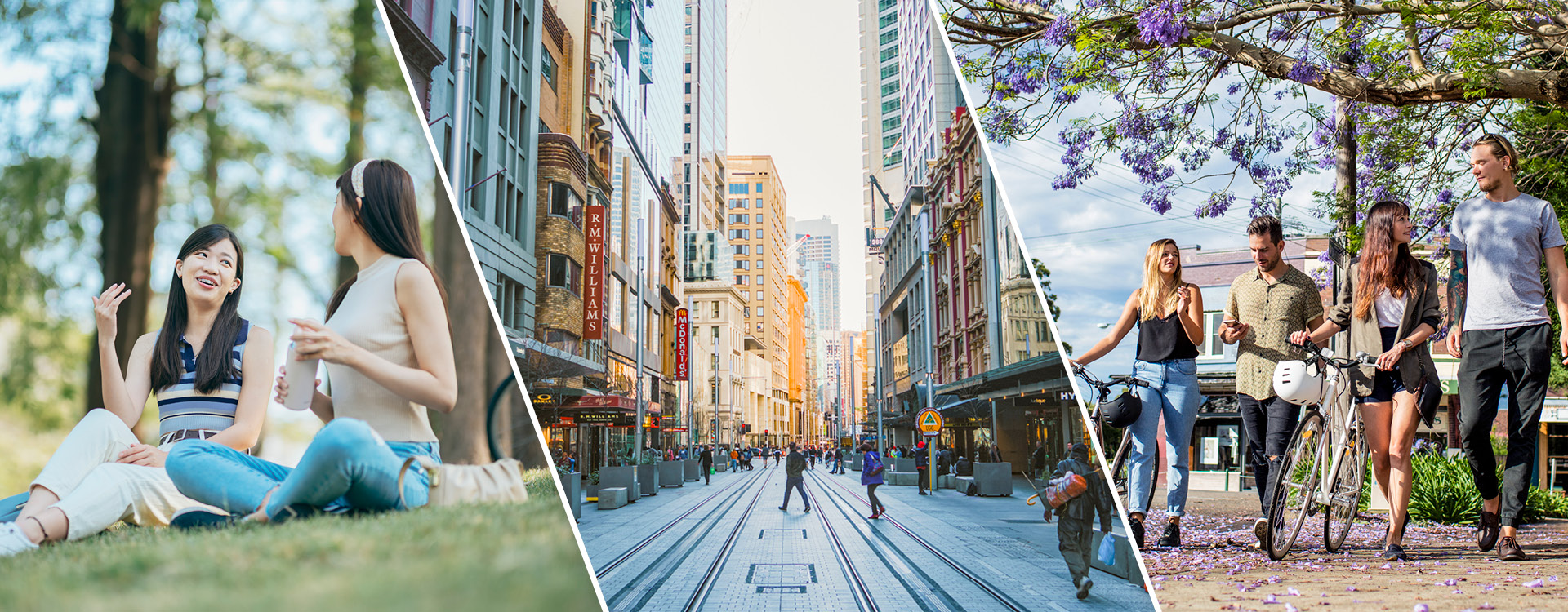
Previously in this ‘changing how we move’ series, we’ve explored opportunities and challenges for decarbonising Australia’s passenger and freight transport, and the future of intelligent transport systems, automated vehicles and a data-enabled, connected transport ecosystem. Here, we turn our focus to transforming cities and neighbourhoods from congested, car-centric spaces into more active, connected, liveable and sustainable places.
As our cities grow and diversify, the transport task changes. Rather than moving people around faster and further, and spending more on transport infrastructure, we can focus on healthier cities with more transport choice. Building a transport future that is place-based and people-centred begins with weaning ourselves off our dependence on private car travel.
Start with the short trips
Sara Stace, WSP’s Director of Cities, says “We can’t expect behaviour to change overnight because we’ve built our cities and lives around cars. However, key things can be done to support the transition and make it convenient, safe and appealing to shift transport modes.”
According to Infrastructure Australia, over two million car trips every day in Sydney are less than 2km long. If we can shift short trips to walking, cycling and public transport then we’re already a long way there.
There also needs to be a focus on creating compact, mixed-use developments around public transport. Enabling people get to their local school, cafes, gyms, parks, GP, groceries or jobs without needing to drive is a major step.
According to Sara, “All neighbourhoods should be walkable, by having lots of people around, things to see and do, and streets that are easy to cross.”
She says providing enough medium-to high-density living is important in achieving this. It doesn’t need to be high-rise. “This might be semi-detached or terrace housing, or three to six-storey apartment buildings. There needs to be regular intersections so people don’t have to walk long distances to cross the street or get from A to B, and reliable public transport, or convenient shared mobility options for longer-distance trips.”
Marc Lane, WSP’s Principal of Cities, says, “Focusing on greater density can reduce or avoid the need for new roads. Greater London has increased its population by over 1 million people since 2000 without any new urban roads. Setting a Vehicle Kilometres Travelled (VkT) target and mode shift target consistent with our Net Zero trajectory would likely see a significant shift in transport spend and better use of existing space.”
Where there’s more density, there can be less distance to cover to reach amenities, or places of work and play, which makes walking and cycling easier and more convenient.
Create welcoming and vibrant places
According to Graham Pointer, Director of Policy at WSP in the UK, “When we create spaces where people enjoy being and feel safe, generally economic value follows.” This is true in Australia too. “Liveability and economic activity are connected; if you want to attract the best talent you need places where everyone thrives,” says Sara.
In her view, “Discussion about mode shift often focuses on what we could lose – removing cars. We need to encourage people to think about what we stand to gain: vibrant productive places where we can achieve healthy, active lifestyles and enjoy clean air, quiet streets, more social engagement and improved mental health.”
Rather than optimising neighbourhoods for shorter journey times, we need to optimise spaces for community interactions. With loneliness and isolation recognised as an increasing problem in Australia, this can’t come soon enough.
Sara explains, “We know that daily exercise is core to public health and yet we’ve built environments where people feel uncomfortable or unsafe walking or riding. We need to rethink streetscapes to make them welcoming and accessible for the whole community, whether they’re walking, using an e-bike, cargo bike, scooter or personal mobility device.”
At a street level, creating great places that are welcoming and liveable can be achieved by “adding in wider footpaths, seating, outdoor dining, shade, planting and water features, low traffic speeds, good lighting and safe cycleways,” explains Sara.
A long-term vision, open to change
When it comes to streetscapes, WSP’s Future Ready Kerbside whitepaper, developed in partnership with Uber, argues that too often city leaders view smart mobility – such as electric, or connected and automated vehicles or even electric scooters – as a threat. Graham, a lead author of the paper, says that “The conversation needs to be flipped to first consider what communities want from their neighbourhoods. Only then should leaders consider how new mobility can support that vision.”
“Future Ready transport planning needs to be flexible about what types of modes could come in the future. While we don’t know exactly what the mix will be, we do know that it’s going to have a range of market solutions,” says Shifani Sood, Associate Principal – Infrastructure Investment Decisions at WSP.
“Going car-free isn’t going to happen everywhere at once,” says Sara, “but if we concentrate on areas with the right ingredients and test things out, people can try it and think ‘yeah, that’s what I want in my life’. We need to offer a long-term vision and take our communities on a journey to get there.”
Getting the planning right is everyone's business
To achieve the outcomes proposed by a place-based approach, we need to better integrate transport and land use planning across every function and stage. Often transport corridors are removed from schools, housing or town centres, or projects lack a mechanism to align decisions to the community uplift effects identified in the business case. For example, Infrastructure Victoria has shown that bus services are often not adequately provided in the few first years of growth, and this lack of frequent and direct bus services means that residents remain car dependent.
Kiersten Fishburn, Head of the NSW Planning Department, declared her desire to end the war between transport and planning. Tools such as LandiQ, a digital twin solution which WSP developed, in partnership with Giraffe and Aerometrix to support the NSW Government, could help government agencies, planners and private providers or developers to work more collaboratively and with the most up-to date information.
Graham says that “Treating transport projects in isolation risks failing both people and places. There is actually no such thing as a transport project.”
“Streets are places too. Streets represent a large area of public space and can play an important role in the social and economic health of communities. The Movement and Place Framework, championed in Sydney’s transport and planning strategies, provides a common language for planners, engineers and the community to identify the best use of streets for both place and people.”
According to Marc, the most important aspect to getting integrated transport planning right is a deep understanding of existing and future needs of communities, combined with available data on transport patterns and a knowledge of the cities and broader region. “Planning should be holistic and practical to implement during the design and delivery phases of the project.”
Great places for people are within our reach, but they won’t happen by chance. This is the time for a fundamental shift in perspective, integrating how we move with how we’d really prefer to live in an era of climate change, and cost of living challenges.
Click to learn more about how WSP is changing how we move, or contact us.