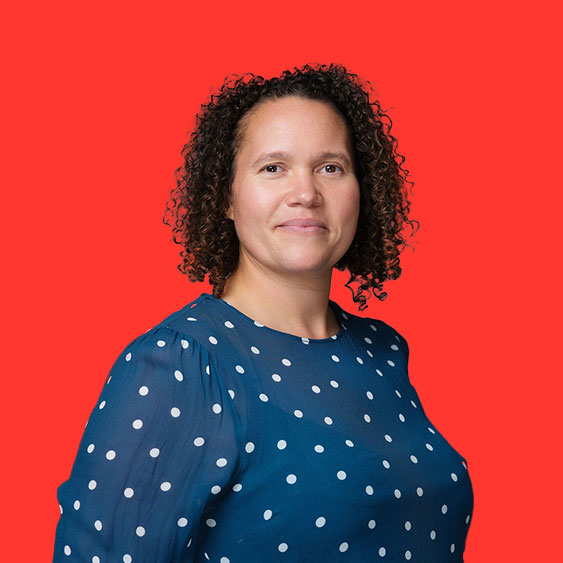
The Connection Changemaker linking stations and people
Aleshia Perry’s superpower is bringing people together. She thrives on connecting people to each other via new rail developments, and encouraging engineers and other specialists to connect with communities, stakeholders and each other.
She was drawn to the rail industry because of its sustainability and safety benefits, as well as how it connects communities and makes places more accessible and liveable.
Taking cars and trucks off the road is good for reducing emissions and for safety,” Aleshia says. “I also love to travel and jump on and off trains to get where I want to go quickly, safely and cheaply.
Aleshia Perry
Major Projects Executive
Aleshia Perry
Major Projects Executive
Making rail work for everyone
For rail projects to be considered a success, Aleshia says “You can’t just look at it like a transit system or a line on a page. You need to bring all the right people and pieces together to achieve the best outcomes for everyone.”
She explains that on the City Rail Link project – for which she was Head of Design and Engineering – a key element of design was engaging with people living with disability. “We heard feedback such as the need for more textured area on the platforms, and more colour contrast between the platform and lines,” she says. “Even though we follow accessibility standards, this kind of feedback from people with lived experience can push us to do even better for truly accessible, inclusive stations.”
Engaging early with emergency services stakeholders was vital for safe design. “We engaged with emergency services early and also used digital innovation to test the design,” she says. “In a virtual reality environment, we simulated a train tunnel fire to see if emergency services and equipment could get in and people could get out. We could see whether there was confusion or whether people could see the exit signs, so we could fix any issues in the design.”
Safe, efficient design
Fire life safety and ‘safety in design’ are always on Aleshia’s mind. “It’s so important that designers think about the people who will be working with these assets every day,” she says. “For example, if a worker must access a piece of equipment cantilevered off a bridge, could it be brought closer? Could there be a better handrail and walkway? Would a person of average height have to climb and twist and turn?”
She brings this focus to construction, too, and is keen to embrace the safety benefits of modularisation and modern methods of construction, as well as their potential for more consistent quality and reduced time, cost and carbon emissions. “It’s generally much safer to build some components in the controlled environment of a factory rather than in a challenging confined space such as a rail tunnel,” she says.
“We need to do more out-of-the-box thinking about how we can make construction and maintenance quicker, easier and safer,” she says, “while also finding the right balance between standardisation and innovation.”
A human-centred approach to systems integration
Aleshia’s focus on people also infuses her approach to systems integration. “Getting systems integration right is about much more than the technology,” she says, “and like any change, there needs to be a good transition plan.” She says it comes down to deep engagement with the people who will use the systems. “We need to understand what they do and how they use what they already have, so that we can keep what’s good and bring it together with the new, rather than losing it entirely.”
Working together to solve problems and shape the future
On rail projects across the world, Aleshia has worked with very diverse groups of people. She loves to build connection with others by talking face to face. “We all have things to bring to the table,” she says, “and it is so much easier to solve problems when we get into the same room, or pick up the phone, or turn on our cameras.”
This collaborative approach attracted Aleshia to engineering from as far back as a Grade 9 group exercise to design a photosynthesis-powered building. She knew instantly that engineering was for her: “Working together to solve a problem – I was in,” she says.
Aleshia encourages other young people – especially young women – to consider engineering and to not hold back from leadership positions. She is always willing to share her story and her passion for working with people to solve important problems.
Auckland’s City Rail Link was a significant project for Aleshia, leading a team of more than 150 specialists, project engineers, planners, schedulers and contractors to resolve complex technical issues – and she’s bringing that experience to rail projects in Australia with infectious enthusiasm. “It’s always a new day, always changing,” she says. “It’s so exciting to be leading projects that will shape our cities for a sustainable future and help generations thrive and connect.”
Contact Aleshia or click to learn more about how WSP are Changing How We Move below.