Government and industry joined together at an Infrastructure Association Queensland (IAQ) roundtable event earlier this year to discuss opportunities and challenges in putting sustainability front and centre in planning for the 2032 Olympics and Paralympics.
Louise Van Ristell, CEO, IAQ, says the roundtable provided the opportunity for all stakeholders to explore a climate positive games and work in collaboration for all aspects of delivery.
Attendees focused specifically on the impacts of supply chain stress and real world examples of how this is being mitigated, and ways to improve and value natural capital through infrastructure projects.
Why the emphasis on a climate positive Olympics?
Brisbane is the first host city in Olympic Games history to be contractually bound to produce a ‘climate positive’ Games. This obligation is part of the International Olympic Committee’s (IOC) ‘New Norm’ framework for host cities. Introduced in 2018, the framework encourages cities vying to host to submit bids that combine delivery (cost, complexity, risk and waste) with value (flexibility, partnership, efficiency and sustainability). Delivering a ‘sustainable & resilient’ Games is one of Brisbane’s five key bid themes.
From 2030, all host cities must deliver a climate positive Olympic Games.
So, what does a climate positive Olympics look like?
To take home the gold, Brisbane 2032 Olympics must offset more carbon emissions that it produces. As part of delivering a climate positive Games, Brisbane will also minimise emissions in line with the Paris Agreement and what science says is required to limit global warming to 1.5°C
In this article, industry representatives share their insights of how decisions need to be made now to meet this commitment made to the IOC, and to future generations.
Working for – not against – the environment
Queensland is renowned around the world for its spectacular biodiversity and the Olympic Games provides a unique opportunity to showcase it to a global audience.

South East Queensland is particularly vulnerable to the impacts of climate change. Brisbane, where the vast majority of venues are located, sits on a flood plain. The city has experienced severe weather events in recent years with many areas still recovering from the deluge that resulted from heavy rains and subsequent flooding in 2022. It is highly possible we will experience another event like this while planning and building for the Games. Works undertaken for the Olympics must preserve and enhance the existing environment and be climate resilient. Building enduring infrastructure that is sympathetic to the natural environment and that is developed using Future Ready™ design and construction techniques will provide benefits long-term.
The city and industry are already working to mitigate the impacts of climate change. An offsetting strategy is seeking to increase investment in new carbon offset projects. New assets such as the soon to-to-be completed Neville Bonner Bridge (pictured) are also Future Ready designed to cater for current and future climate change impacts. The bridge is designed to withstand cyclonic wind speeds and to resist extreme one in 2000-year flood events and vessel impacts, ensuring that it will provide long-term benefits for residents and visitors.
Building for the long-term
Past Olympics have been marked by infrastructure that have been rendered obsolete after the Games. It’s a scenario the IOC is keen to avoid with the ‘New Norm’ and legacy outcomes are a key driver for the Queensland Government. The government has established a dedicated Legacy Committee and recently undertaken a survey to establish the Brisbane 2032 Legacy Plan. A paper is anticipated to be released for consultation.
David Symons, Future Ready Global Leader, Director - E&E, WSP UK, says “Delivering a world class Games is key, but that this should draw on both best practice from other Games, as well as planning for the future changes that Brisbane will see, and helping get the city Future Ready. Key future challenges include the Net Zero transition, delivering adaptable, reusable venues and helping the city get ready for future weather extremes, as well as creating venues and districts that are water lean, biodiverse and accessible for all.”

Collaboration and a clear framework are key
With under a decade to go and unprecedented costs and supply chain issues being experienced by the building and construction industry, it’s critical that industry and government work together to deliver the Games in as cost-effective and timely a manner as possible, whilst putting sustainability front and centre. A sustainable Olympic Games and Paralympic Games doesn’t just make sense from an environmental standpoint – it makes good fiscal sense.
Industry leaders are keen to embrace sustainable built development however, they are seeking clarification from government regarding a clear framework to work to. The aforementioned Brisbane 2032 Legacy Plan is likely to be a key component in guiding the approach moving forward. Industry is also advocating for policy changes as a necessary part of the procurement process, in order to increase productivity and collaboration between stakeholders.
Pat Campbell, Operations Sustainability Manager, John Holland, says “Concise messaging to the construction industry in South East Queensland in regards to sustainability targets and requirements is crucial for the Games and preceding projects. Achieving the best outcomes for the environment and for the Games' budget requires early engagement with the Queensland and broader Australian supply chain including local manufacturing. Achieving sustainability outcomes that will improve the lives of Queenslanders requires early engagement with the Queensland and broader Australian supply chain including local manufacturing.” 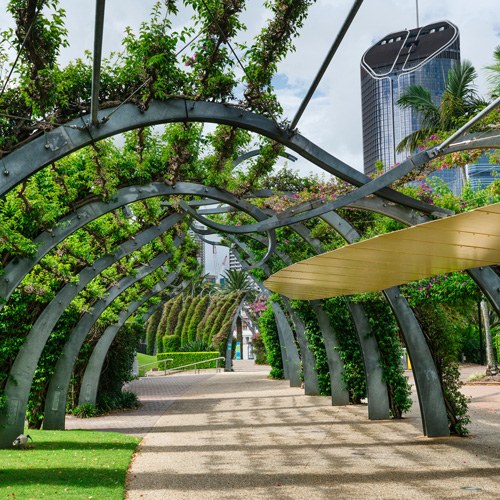
Ben Gibbs, Director – Sustainability & Climate Change Advisory, WSP Australia, says “To ensure the success of achieving a climate-positive Olympic Games, a robust strategy should be developed that not only embraces this overarching ambition but also translates it into tangible sustainability and emissions reduction mandates for each infrastructure project involved.
“By providing design teams with clear and comprehensive targets from the outset, we can empower our architects, engineers and contractors to collaboratively pursue the optimal solutions.”
Under the requirements of hosting, new venues that need to be constructed must aim for a 6-star Green Star building rating. Achieving a 6-star rating across new infrastructure would position Brisbane as a sustainability leader on the global stage. Integrating environmental performance throughout each step of the planning process can pay-off financially as well with reduced energy and water bills once complete.
Given the portfolio of infrastructure assets included in the 6-star requirements, Ben says that there are significant opportunities to create sustainability value at scale and to incorporate a time and cost-efficient approach to achieving the targets.
“A program or portfolio approach would provide benefits including a consistent method for resilience assessments, material selection and reuse opportunities outside individual sites and low emission transport planning,” says Ben.
Success must be measurable
The Queensland Government intends to use Climate Active, Australia’s national standard for verifying carbon neutral claims, to mark the state’s achievement. Other industry benchmarks will be crucial in ensuring that Brisbane lives up to its promise of a carbon positive Olympics Games. These include the Green Star Rating System and the Infrastructure Sustainability Council’s rating tool which will be used for all horizontal infrastructure.
Cities all over the world compete for the honour of hosting the Olympic and Paralympic Games but it has typically come at an environmental cost with many venues falling into despair and disuse after the events wrap up. Brisbane has a prime opportunity to show future host countries how it should be done moving forward. Setting a clear, consistent pathway for industry will deliver enduring climate benefits for Queensland and assist with positioning the state as a world leader in sustainability.
Projects we're already engaged in
|
Ballymore National Rugby Training Centre in Herston, Brisbane is the first dedicated home for women’s rugby in Australia and home of women’s rectangular sport. The facility will play a significant role in sport and in the community – including the 2032 Olympic and Paralympic Games.
Our team provided design services throughout the project in areas including structures, civil, flood engineering, electrical, mechanical, hydraulics, fire engineering, vertical transport, traffic, acoustics and specialist lighting.
WSP is proud to have worked alongside the Queensland Rugby Union (Queensland Reds) and our project partners – Buildcorp, Blight Rayner Architecture, RPS, Rider Levett Bucknall, McKenzie Group Consulting and SPORTENG - to deliver this project.

|
To stay up-to-date with our latest information, publications, videos and posts, please subscribe to our news or follow us on LinkedIn.