A city's airport and an individual’s journey from the airport to their destination is often the first impression visitors have—a gateway to a city or even the country.
An airport that offers a scenic, fast, direct and efficient passenger rail network connecting travellers to the heart of a city is a great way to boost a city’s value – accessibility, mobility and liveability. At the same time, a rail connection benefits a region's residents by allowing for seamless trips, connecting them to other places and reducing congestion on the roads and areas surrounding the airport and reducing carbon emissions.
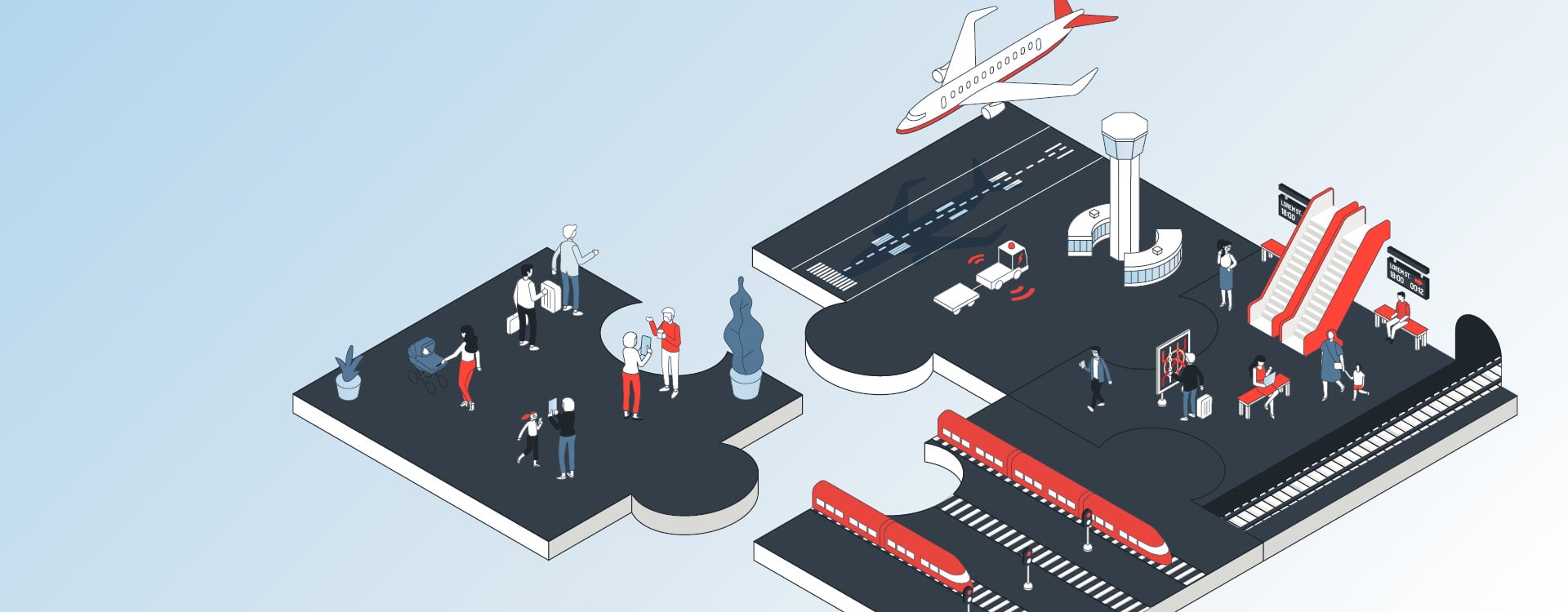
But when an airport rail system is being installed at a major operational airport, achieving exceptional outcomes for the rail project that balance the need of the airport operators and customers become a multi-disciplinary design and construction puzzle; with rail systems airport operators, engineering and architectural designers and construction contractors coming together to contribute to a design that balances continuity of operation with customer experience.
What is the first piece of the puzzle?
Understanding the existing conditions and creating a digital model of the airport and all the underlying utilities is critical.
"Airport rail links are unique," says Doug Williamson, Regional Executive Victoria and South Australia.
"It's not like a traditional rail project where there is an option to close the line for a period of time for construction works, and you can’t just bus people around. An airport (without curfew) continues to operate around the clock and the design and construction methodologies need to recognise that."
"Airport rail links tend to be new lines, so it makes it easier than upgrading existing rail lines as we can adapt the rail alignment to the physical, operational and cost constraints to get the best balance. In the case of the Melbourne Metro for example, we adapted the alignment from the reference design for the Metro Tunnel to improve user experience and construction methodology at stations while minimising the impact to the public during construction."
Puzzling it out in digital
Back to the original question of how we would we design and construct new rail infrastructure at a major airport while maintaining its operations?
"We would build the job digitally before you put a spade in the ground and then work backwards through the different stages to deconstruct it and work out the best equipment, materials and methods and how they incorporate with airport operations," explains Doug.
"The staging and constructability are crucial in an airport with height restrictions for plant, multiple critical utilities, access roads to car parks, drop-offs and back of house operations and accessibility for customers and staff."
Brett Buhagiar, Digital Engineering Operations Lead says, "The great thing about having a model-first approach is that we can commence engagement with various disciplines earlier in the design process. For example, as our designs progress, we can track material resources and associate this to embodied carbon content, allowing our sustainability teams to target the areas that will have the most impact whilst we still have flexibility in the design decisions that are being made."
WSP has done this on the City Rail Link in Auckland, where data is integrated across all aspects of the project to automatically feed information from the digital model into the Infrastructure Sustainability Council of Australia [ISCA] materials calculator. All stakeholders are engaged and informed; designers, constructors and management stay focused on the project's sustainability.
"Modelling will also allow testing different scenarios, running through all your safety requirements and mitigating the risks through stakeholder review processes," explains Brett. "The visualisation aspects of modelling software expedite coordination with different members of a project team – particularly non-technical stakeholders – and get everyone one on the same page to plan out and mitigate any potential construction impacts. They also allow cross-discipline interactions that help us identify creative ways to work with the airport constraints and optimise safely in a digital environment to mitigate any risks from shutting down the airport."
Visual simulations and methodologies identify and resolve issues using a 4D model and can assist in demonstrating safety, usability testing and user experience across the station for all users.
Sydney Metro West do virtual reality user testing in the station environment. By virtually simulating being in the full station, participants were able to comment on the process of moving through the environments and how the environments made them feel.
Piecing together an integrated solution
Any rail station design needs to fit within the existing communities, businesses and infrastructure which means coming up with designs that can be constructed within a tight environment, especially when building near an airport. The tight, busy environment, where the airport must always remain operational, requires engineers and contractors to work closely together to create future ready solutions – those that are flexible, adaptive and innovative.
"It is a balance to make sure the finished product is human-centred while also being able to construct in a restrictive environment that doesn't affect people travelling through the airport" says Tom Cooper, Former Director of Bridges, Maritime and Structures.
"The way people get in and out of a station at the airport is very different to an urban commuter station. We need to design it with a diverse range of users in mind, from the whole family travelling with multiple suitcases, the international traveller who doesn't speak the language, the leisure retirement travellers through to the businessperson."
Mark Boone, WSP Australia's Former Aviation Lead, says, "An Airport and the infrastructure around it is often the first impression of the city that our visitors see; therefore, any station design must create an excellent user experience. The airport rail station has the potential to serve as a gateway moment to the city and region.”
By adopting a human-centred design approach and using tools such as virtual or augmented reality, we can undertake a process to test and understand how diverse groups of people will use the facility to create a highly functional commuter station.
Drawing on international expertise for local solutions
Mark worked on the Regional Transportation Centre concept for the Toronto Pearson International Airport. The drivers for the project were to raise the profile of other more sustainable modes of access to the airport to reduce the reliance on the car. A new passenger processing facility was contemplated to integrate the rail and air travel experience seamlessly. He says, "It doesn't get any more challenging than working close to the terminal and bringing in heavy rail infrastructure."
"This is the benefit of working with a global company like WSP – we always draw on our global network of professionals and subject matter experts who have experience with delivering airport rail connections around the world including the Toronto Pearson International Airport, Seattle–Tacoma International Airport and San Francisco International Airport; and we can apply the lessons learned to Australian projects."
What about the sustainability angle?
"Airports and their structures have a long lifespan, so it is essential to consider the airport's growth when designing the rail corridor and the station," says Bernadette Fitzgerald, Director – Sustainability.
"Sometimes, the key outcomes of a major project like an airport rail service get lost in the complexities of delivering it, but essentially any airport rail is about creating a more sustainable airport and city. Less cars, more use of electrified rail and a more convenient and pleasant air travel experience for everyone."
"With that in mind – the rail station placement and access must work for the whole life of the airport and be the preferred transport mode for airport customers. It must consider how the station can allow the airport to grow around it as well as considering climate and carbon impacts, and the ability for it to be modified in the future for connecting structures. In short, we must apply a future ready lens.
"This also means that the station project should consider all aspects of the carbon lifecycle to assess net zero carbon ," explains Bernadette.
"We look at every aspect of the project to decrease the impact on the environment from reducing the height of concrete and minimising how far we build underground to the most efficient alignment for materials as well as the rail alignment gradient impacts on traction power, and less obvious but more importantly – how many people will shift to this as their preferred transport mode."
A successful strategy to piecing it all together
Putting the pieces together to design and construct an airport rail link also requires a dedicated multi-disciplinary team who know how to communicate the finished puzzle and the infinite amount of details.
"While aviation is an international set of standards, the challenge is having the people and the mindset. It's about trust with the team. We actively engage with clients and stakeholders throughout the entire journey" says Mark.
"We are a global team, but we are locally dedicated, making sure we balance providing a bespoke solution for the community we are working in."
For more information, contact us below.