Accessible public transport infrastructure is a major priority for the NSW Government. It’s an important part of the solution to the state’s ongoing and increasing challenges of road congestion, and a crucial step towards reducing the greenhouse gas emissions associated with heavy traffic. But to make public transport convenient and appealing, commuter car parks are needed at key transport interchanges.
WSP was recently engaged as a Sustainability Consultant to support the NSW Government and their delivery partner AW Edwards with Sustainability, Indigenous Specialist Services and Digital Services on the Leppington Commuter Car Park (opened in November 2021) and the Edmondson Park South Commuter Car Park (opened in February 2022).
We’re proud to say that these are no ordinary car parks, going well beyond their basic purpose of convenience for commuters by also incorporating significant sustainability and future-ready features and by contributing to the amenity of their locations as large-scale canvasses for the work of a local Aboriginal artist. We think of these dual benefits as two different ways to care for Country.
Building for a Net Zero future
The car parks have been designed to achieve a carbon-positive outcome, considering whole-of-life emissions including construction activities, embodied emissions from materials, and 50 years of operation. Key initiatives to achieve this Net Zero vision include the incorporation of rooftop solar PV, which generates 2.3 times the amount of energy required by the car parks. These car parks also include electric vehicle charging stations to encourage the shift to low-emission vehicles. Other energy savings come in the form of highly efficient LED lighting with motion sensors and daylight dimming sensors.
The structural design and construction materials also contributed to the sustainability target. The designs were optimised to reduce the amount of concrete and reinforcing steel needed – and sustainable choices were favoured when selecting the required concrete and steel. A concrete mix was selected that has an average 35% recycled material to replace Portland cement. The reinforcing steel procured has an estimated 65-80% recycled scrap content and Environmental Product Declarations demonstrating lower embodied carbon.
The designs also included sustainable water solutions, including a rainwater capture system.
For both car parks, the overall embodied carbon emissions are expected to be reduced by an estimated 18%, equating to 3,866 tonnes CO2-e avoided. The remaining embodied carbon emissions will be more than offset through operational carbon emission savings over 50 years.
Dayna Surlan, one of WSP's Sustainability Design Consultants says, “We helped re-envision a car park beyond being a concrete shell that doesn’t give much to the surrounding area or the suburbs. This is a piece of art that really contributes to the urban location and the heritage interpretation of the area. It brings back some Indigenous knowledge into the land, which is so incredible.”
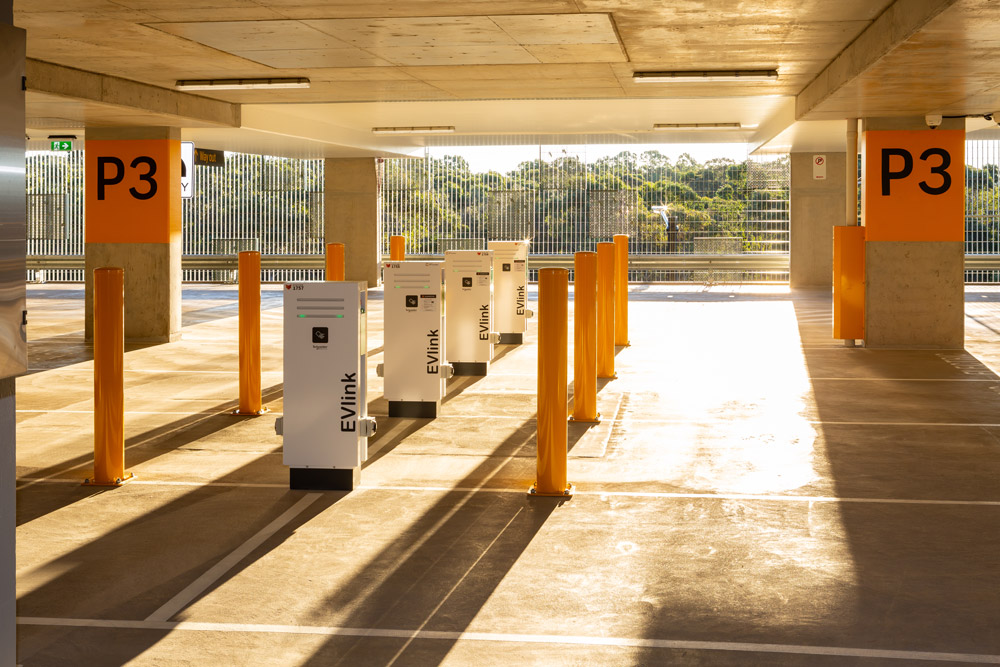
Image Courtesy of Transport for NSW
Leppington Commuter Car Park - Electric vehicle charging spaces at Leppington multi-storey commuter car park
Inspiring the community with Aboriginal art
In early design meetings, an opportunity to acknowledge Country by incorporating Aboriginal artwork into the project was raised. WSP brought in Michael Hromek, our Technical Executive of Indigenous (Architecture), Design and Knowledge to present an ‘Aboriginal Design Principles’ concept to the design team, which included AW Edwards, Caldis Cook Group (the architect) and TTW (civil, structures and facade design).
“In the initial workshop, we wanted to get everyone aligned with our principles and methodology, pass on some introductory information about the language groups and ancestral groups, and increase the cultural competency of the team,” says Michael.
One of the concepts we presented to the design team was to incorporate an art piece 'Where Sky Meets Earth' by Darug artist Dr Shane Smithers into the façade design, a vision that particularly impressed the team.
“When we showed a mock-up of Shane's artwork ‘Where Sky Meets Earth, 2021’, everyone responded enthusiastically, adds Michael. We provided different view and angles of the artwork to give a better idea of what it could look like on the facade of the car park, showing potential patterns, colours, and complexity of treatments.”
Commenting on the project, David Oliver, Senior Design Manager of AW Edwards says, “We have been looking for ways to recognise the Aboriginal heritage of lands that our projects are on. For us to get the opportunity to create these façades that are a real, permanent visual message, has been very satisfying. Accompanied by an interpretive sign that explains the story behind the artwork, hopefully people are engaging with the history. To us, that's a real contribution to the community."
Michael adds, “We were very keen to bring to life the fact that every different Country has a different design vernacular. Shane’s outcomes are fantastic, but it is also very important that his work is culturally legitimate and uses the local Darug vernacular, such as using lines, not dots.”
WSP brought Shane into the project team to attend site visits and design meetings, and through a co-design process, Shane helped the team to interpret his artwork into the façade design.
Shane explains, "This artwork is about this abundant country where the generative forces of the sky and earth come together to create life. This is the place where I live, where you live, where we live, together walking on the earth, touching the sky." Part of the Burraberongal clan, Shane described the vertical white lines as representing our connection to sky, meeting the horizontal red lines (connection to earth) as an abstraction of the Darug 'Country pattern' which is a simple hatch, 'spread out like a checkerboard suggesting that the sky meets the earth, as a blanket covers the ground'.
The outcome of this successful co-design process between an Aboriginal knowledge holder and the project design team is a large-scale interpretation of a contemporary Darug artwork, rendered in glorious scale on the façade of the Leppington Commuter Car Park.
Michael says that his favourite part of the project was being able to “Turn a car park into a canvas for Aboriginal art which we don’t often see, particularly at that size and scale.”
Following the success of the co-design process for Leppington Commuter Car Park, Shane's artwork ‘Ghost Trees and the Lost Woodland, 2021’ was similarly translated into the facade of the Edmondson Park South Commuter Car Park.
The two car park projects have been described as landmark projects for Transport for NSW – both for their standout Net Zero credentials as well as their sensitive incorporation of Indigenous design concepts and aesthetics.
By caring about climate change and the environment, we are caring for Country. By bringing Aboriginal art into our urban fabric, we bring Country to the city and into the daily life of all its inhabitants.
For more information on our involvement on the NSW Government’s Commuter Car Park Program, contact us.
To stay abreast of our latest information, publications, videos and posts, please subscribe to our news, follow us on LinkedIn.


