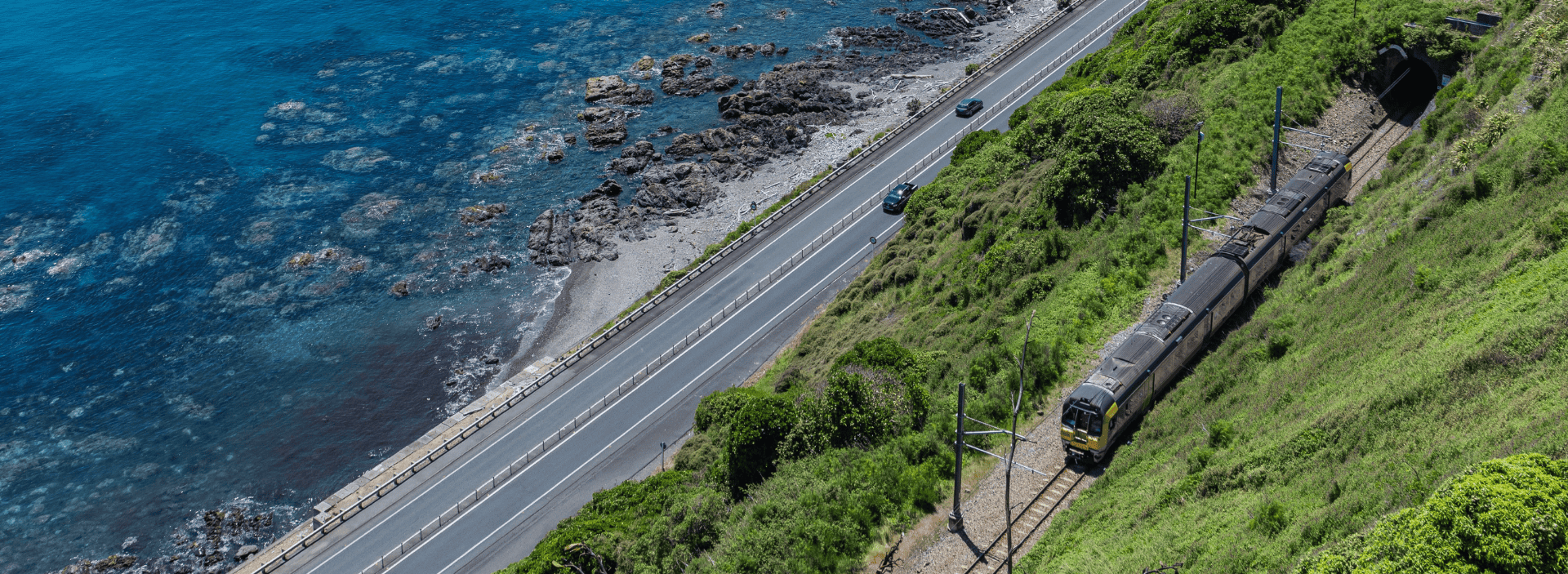
The new system has been a major success, guarding 60,000 daily passengers. The project was also recognized with the prestigious ACENZ Silver Innovation award.
“I would say the project is definitely beneficial for us,” Said Urvaksh. “It has made the network safer, and safety is our highest priority. This line is especially critical, so we need it to be quite resilient.”
The technology deployed on the Kāpiti line has numerous other use cases across New Zealand and around the world. WSP is currently working to help install the system on a section of Wellington’s Johnsonville rail line, which KiwiRail also manages.
Additionally, in October 2025, the client reached out to our Kāpiti project team in response to an emergency at a national park near the rural community of Ongarue. Major rainfall and flooding resulted in geotechnical instability and landslides in the historically unstable area, which is near the site of an infamous 1923 railway disaster where a train collided with a boulder dislodged by a landslide. KiwiRail reached out to the team after hours on a weekend, but even with that short notice, we installed instrumentation across the affected area within a week.
The client is also working to make the solution available throughout the organisation, allowing personnel to request access for their own projects, with plans to integrate the monitoring technology into their new train control solution. In addition to that work, KiwiRail recently awarded us a project to combine all monitoring across their national network into a single WSP dashboard.
And the benefits go beyond the tracks. The team also successfully deployed it for other clients, notably to help the New Zealand Transit Authority repair and maintain the road in the Mangamuka Gorge. In 2022, the 14-kilometre road was heavily damaged by ground movements. The team leveraged lessons and practices developed during their work with Kiwi Rail to help fix the road and guard against future incidents.
The solution has strong potential uses throughout New Zealand, which is particularly vulnerable to landslides due to the country’s geography. But the technology shows promise outside of New Zealand too, especially as our world faces worsening weather conditions due to climate change.
Jazz Pabla, Chief Innovation Officer and Regional Digital Lead for WSP Canada, recognises the unique importance of this project, “When I heard about KiwiRail, I was super proud that WSP had developed this and then immediately thought, ‘OK, we need to bring this type of technology to our clients and communities in Canada as well.’ I felt just a bit of a wow factor that we had this and that it was something real and had actually saved lives in New Zealand.
Right now, we're setting up the same instrumentation for a community in British Columbia, in a key area where landslides have occurred. We're quite excited to follow in the Kāpiti Line’s footsteps, it's a strong product and it's great that WSP can show that a true innovation mindset really does exist and more importantly, it exists in the form of a tool that saves lives.”