Reimagining a 1940s pump station
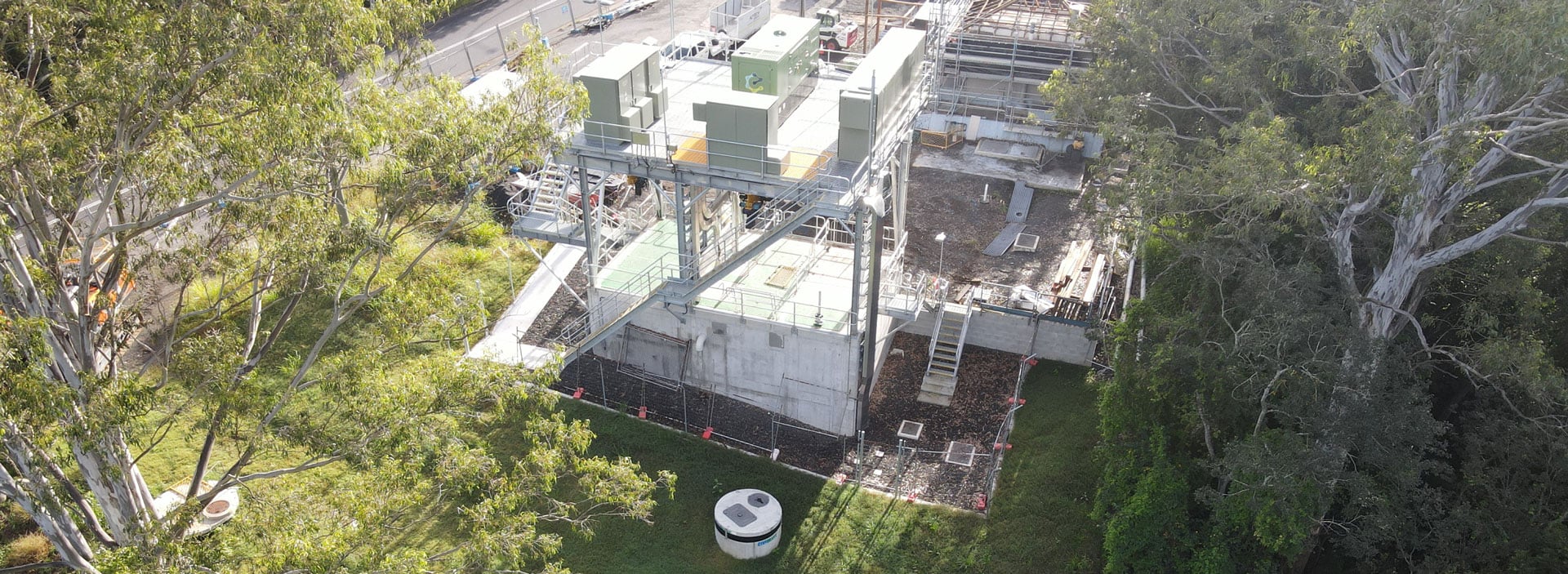
The Tantivy Street Sewage Pump Station (SPS) upgrade in Ipswich, Queensland, stands as a transformative example of purpose-driven engineering in the Australian water sector. Originally constructed in 1941, the pump station had served the community for over eight decades. However, by the early 2020s, it had become one of Urban Utilities’ highest-risk assets due to its deteriorating condition, poor maintainability, and vulnerability to flooding.
The station’s location—wedged between the Bremer River, Tivoli Creek, and a busy transport corridor—presented significant spatial and environmental constraints, making traditional upgrade approaches unfeasible.
Urban Utilities engaged WSP to lead the design of a future-ready, flood-resilient replacement. Downer was appointed as the construction partner, forming a collaborative delivery team that would navigate the site’s complexities while maintaining uninterrupted service to over 39,000 residents.
The project commenced in 2023 and reached operational completion in March 2025.
Navigating constraints and operational continuity
Delivering the Tantivy SPS upgrade required overcoming a confluence of technical, environmental, and operational challenges. The site itself was exceptionally constrained –bordered by a state controlled road, two flood-prone waterways, protected vegetation and residential properties. This left virtually no room for traditional construction methods or horizontal expansion.
The existing pump station featured a deep dry-well configuration that was difficult to access and maintain. Despite its age and deteriorating condition, the station had to remain fully operational throughout the upgrade to avoid service disruptions.
Flood risk was also a critical concern. The site sat within a 1-in-100-year floodplain, and historical events had demonstrated the vulnerability of electrical infrastructure to inundation. Any new design would need to ensure immunity from future flood events, including extreme weather scenarios with a 1/2500 annual probability of exceedance for wind and seismic activity.
Additional constraints included overhead 11kV power lines, which imposed safety hazards and height restrictions, and the proximity of residential areas, which required careful management of noise, odour, and community engagement. Environmental sensitivities along the Bremer River and Tivoli Creek added further complexity, necessitating rigorous compliance with ecological protection standards.
The project team faced the challenge of integrating temporary works with permanent infrastructure. Excavation adjacent to the live pump station demanded precision and stability to avoid compromising the existing structure. These challenges required not only technical expertise but also a collaborative mindset and a willingness to rethink conventional approaches to pump station design and delivery.
Elevating infrastructure through 'vertical thinking'
In response to these multifaceted challenges, the project team implemented a suite of innovative and integrated solutions that redefined the boundaries of conventional pump station design.
Central to the approach was the development of a bespoke vertical configuration, a stacked design that maximised spatial efficiency while elevating critical infrastructure above flood levels. This allowed the wet well, switchboard, and generator to be housed within a compact footprint, mitigating flood risk and improving operational safety.