‘How can we design for net zero?’ was the theme of the October 2020 Future Ready Innovations Lab focusing on the application of net zero thinking. Project examples for today’s needs were discussed together with interactive consideration of issues and actions to make infrastructure ready for the future. Chaired by WSP Australia’s Future Ready Lead Graham Pointer, presenters included Nolan Nel, Principal Resources; Katie Fallowfield, Director Sustainability and two of our Water Treatment Senior Engineers Tanu Kaur and Matt Lyon.
‘Net zero emissions’ refers to achieving an overall balance between greenhouse gas emissions produced and greenhouse gas emissions taken out of the atmosphere.
The net zero target was driven by the Intergovernmental Panel on Climate Change’s Special Report Global Warming of 1.5°C, released late 2018. The landmark Paris Climate Agreement succeeded where past attempts failed because it allowed each country to set its own emission reduction targets and adopt its own strategies for reaching them. It also recognised the role of local governments, businesses, investors, civil society, unions, faith and academic institutions as critical to meeting the 1.5°C goal.
In many sectors of the economy, technologies exist that can bring emissions to zero. In electricity, it can be done using renewable and nuclear generation. A transport system that runs on electricity or hydrogen, well-insulated homes and industrial processes based on electricity rather than gas can all help to bring sectoral emissions to absolute zero. However, in industries such as aviation the technological options are limited; in agriculture too, it is highly unlikely that emissions will be brought to zero. Therefore, some emissions from these sectors will likely remain; and in order to offset these, an equivalent amount of CO2 will need to be taken out of the atmosphere – negative emissions. Thus, the target becomes ‘net zero’ for the economy as a whole. The term ‘carbon neutrality’ is also used. (Energy & Climate Intelligence Unit, UK)
Business and local government leaders are supporting strong national climate ambition through the U.N. High Level Climate Champions’ Race to Zero campaign. The global initiative sets minimum criteria for designing net zero targets, asking regions, cities, businesses, investors and civil society to pledge to reach net zero by 2050 and submit a plan in advance of the U.N. Climate Summit in 2021. This comes on the heels of the U.N. Secretary General asking countries to come forward with net zero targets. In addition, a growing number of countries have joined the Climate Ambition Alliance with aspirations to reach net zero emissions. (World Resources Institute (WRI) 12 August 2020)
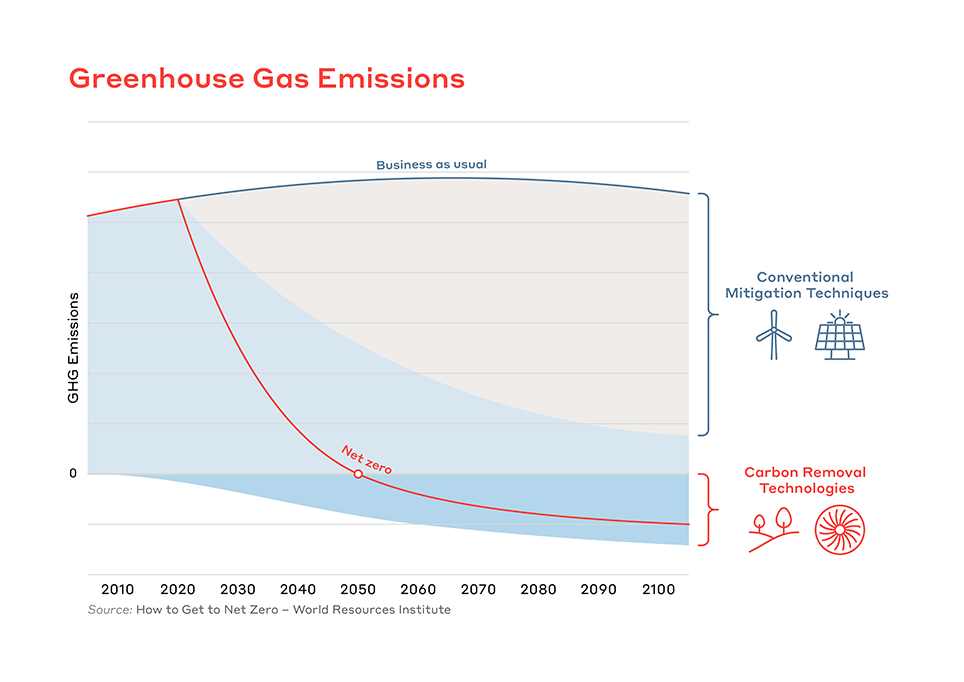
Which countries have Net Zero targets?
As of June 2020, 120 countries are committed to working on net zero targets through the Climate Ambition Alliance. 20 countries and regions have adopted net zero target in law or policy – Austria, Bhutan, Costa Rica, Denmark, the European Union, Fiji, Finland, France, Hungary, Iceland, Japan, the Marshall Islands, New Zealand, Norway, Portugal, Singapore, Slovenia, Sweden, Switzerland and the United Kingdom. This does not include targets in political speeches, such as China’s announcement. However, only around 10 per cent of global emissions are covered by some form of an adopted net zero target. Some net zero targets have been incorporated directly into countries’ commitments under the Paris Agreement. (WRI 12 August 2020).
In Australia, all states and territories have committed to net zero by 2050.
The Australia Institute’s 2020 Climate of the Nation report shows that the COVID-19 crisis has strengthened Australians’ resolve for all levels of government to take action on climate change, with 68 per cent believing Australia should have a national target for net zero emissions.
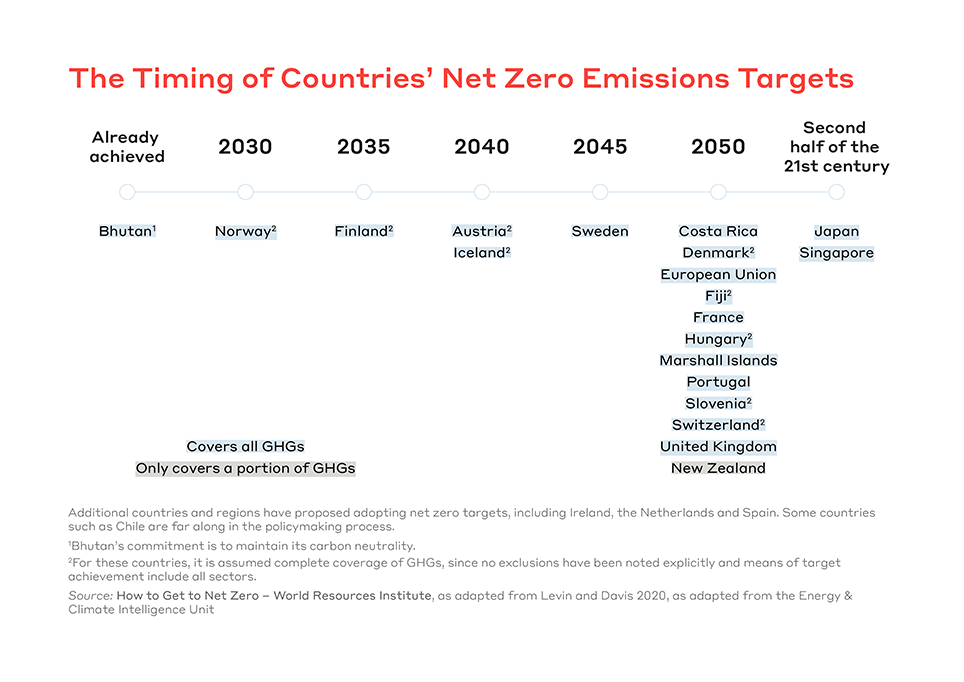
How do we achieve Net Zero emissions?
The Reserve Bank of Australia and 65 of its peers recently released a report, warning that failing to slash emissions to zero could wipe 25 per cent off global GDP by the end of the century.
To meet net zero by 2050, the world will have to invest in reducing emissions in infrastructure. Climate change initiatives focused around repairing and upgrading infrastructure around the building sector are compelling. The US loses 7,000 Olympic size swimming pools of water every single day from leaking pipes and burst water mains. Bringing water infrastructure up to standard will require a massive amount of capital. Buildings will need to be made more efficient, and transport, manufacturing and agriculture sectors will also require significant investment. (Money Management 22 Oct 2020)
In July this year some of Australian industry’s biggest companies announced an initiative to work together to better understand pathways to achieving net zero emissions in supply chains. BHP, Woodside, BlueScope Steel, BP Australia, Orica, APA Group, Australian Gas Infrastructure Group and Wesfarmers Chemicals, Energy and Fertilisers – which together represent 14 per cent of Australian industrial emissions – have signed on to the Australian Industry Energy Transitions Initiative. They are joined by National Australia Bank, Schneider Electric and AustralianSuper, who represent the broader system of investments, services, products and knowledge that will be key to supporting industry action towards net zero supply chains. (climateworksaustralia.org 27 July 2020)
Speaking during the seminar, Nolan Nel, Principal Resources discussed ways to integrate sustainability to achieve net zero in the resource, process and heavy industries.
“Understanding, quantifying, measuring and addressing carbon emissions is at the core of climate and environmental sustainability,” stated Nolan. “It is the base tenet for establishing a circular economy and one of the pillars of the Third Industrial Revolution.”
Nolan outlined the three emissions categories set by the Greenhouse Gas Protocol:
- Scope 1: All direct emissions – from owned or controlled sources
- Scope 2: Indirect emissions – from the generation of purchased electricity, steam, heating and cooling consumed by the reporting company
- Scope 3: All other indirect emissions – that occur in a company’s supply and value chain.
“Scope 3 covers a broad range of emissions from an organisation’s activities – everything from wastewater and supply chain procurement through to business travel,” explained Nolan.
“Adoption and implementation of sustainable practices to achieve net zero in mining and heavy industry is currently primarily focused at the front-end of a project during the environmental study stage and in general, only applied if included in a client’s requirements.
“However, an integrated sustainability approach is required to enable global reporting for the TCFD – Taskforce on Climate Related Disclosure.”
Nolan provided three project examples to show how this can be achieved – an underground mine trade-off study for the entire or partial mine fleet conversion to electric vehicles; tailings dam closure final landform options; and a waste-to-energy project showing negative CO2 emissions in the business case.
“In the first example, the influencer was the mine’s financier which had previously voted against financing other companies that showed insufficient progress integrating climate risk. The outcome of the study by WSP enabled the client to incorporate emission reduction targets supporting the project’s survival through the financial scrutiny assessment stage.
“In example two, through quantifying, WSP helped the client to assess the alternate landform options and in example three, WSP was able to identify emissions not previously considered in the business case including those resulting from process and material handling systems, in addition to Scope 1 and 2 emissions resulting from sources other than the process itself such as project construction, and operational and supply chain logistics.”
Achieving Net Zero in regional areas
Katie Fallowfield, WSP Director Sustainability presented the Moree Special Activation Precinct (SAP) project example. The regional town of Moree in NSW was selected for an economic development SAP area as key features include the Inland Rail, rich agricultural land and a reasonable water supply. WSP’s role is to assist the precinct in applying net zero principles to the project.
Katie outlined the sustainable policy drivers for the precinct:
- Australia’s COP21 Paris Agreement Commitments
- UN Sustainable Development Goals
- National Climate Resilience and Adaption Strategy
- Smart Cities Plan
- Regional policies and plans from Moree Council
- NSW Climate Change Policy Framework – objectives Net Zero Plan Stage 1
“The SAP identified six sustainability objectives – alignment of the ‘More Sustainability’ strategy with the UN SDGs (sustainable development guide); application of circular economy principles; a holistic water cycle management strategy; net zero emissions (energy strategy); climate resilience; and also social and cultural sustainability (incorporating Indigenous design),” Katie explained.
“For this project, the Climate Active Carbon neutral standard was applied to the energy strategy which included transport within the boundary of the project and allowed trans-boundary transport to be assessed for relevance.
“Energy strategies include expansion of the Moree solar farm, biofuels, roof top PV and hydrogen production. They also include buying renewables to achieve carbon offset objectives.
“Our approach involves looking at the different scenarios for the project and testing how well they can meet the vision, in particular, meeting net zero targets.
“Sustainable transport options are also being explored including walking and cycling paths, on-demand transport network expansion, hydrogen powered buses, electric industrial vehicles including forklifts, and electric car charging to reduce reliance on private vehicles.
“The outcome for the SAP is provision of infrastructure requirement to undertake these initiatives, for example battery storage for renewable energy opportunities.”
Pathway to carbon neutrality in the Australian water industry
Tanu Kaur and Matt Lyon, WSP Senior Engineers Water Treatment presented their report ‘A pathway to carbon neutrality in the Australian Water Industry’.
Matt outlined the journey from industry analysis through to their findings, “Our research included identifying carbon reduction trends in the water industry and researching existing tools and policies. In developing the technical paper capturing the state of the industry, we also interviewed water utilities and industry bodies to understand current challenges and opportunities that face the Australian water industry.
“In 2020 the Victorian state government published that the water sector is responsible for the largest proportion of Victorian state government emissions, with water infrastructure (wastewater, supply, other water) contributing 24 per cent of emissions. Other emissions sources were rail (19 per cent), healthcare (18 per cent), universities (12 per cent) and schools (8 per cent).”
Tanu continued, “In Australia, wastewater treatment is one of the greatest emitters due to the energy use, methane gas and nitrous oxide. Utilities are at different points on the carbon neutrality pathway, however there are common challenges to be overcome even if timelines are not the same.