Due to its unique position next to the Newell Highway and at the intersection of national rail links, Parkes has become the focal piece of major NSW Government and Parkes Shire Council development plans to encourage economic development in the region and improve livability.
Special Activation Precincts
Special Activation Precincts (SAPs) are defined by the New South Wales (NSW) Government as areas with the potential to activate state or regional significant economic development.
An innovative place-based solution, the NSW government is drawing on the AUD4.2 billion from the Snowy Hydro Legacy Fund towards making future ready regional communities. Specifically, the regions will prosper both socially and economically from the windfalls of major public and private investment to create jobs, attract businesses and investors, and fuel economic development.
The first SAP is located to the west of the Parkes township and centres around the landmark Inland Rail project and existing freight hub. Using sustainable development and circular economy principles the precinct h aims to build upon the region’s thriving freight and logistics and high-value agriculture sectors whilst creating new industry and enterprise opportunities.
SAP Strategic environmental planning, community connection and Indigenous Design
Environmental planning
Since early 2019, our environment team has been working closely with government, industry and the community to develop a sustainable, resilient and Future Ready precinct through the development of the Parkes SAP.
Assisting the Department of Planning, Industry and Environment (DPIE) through their master planning phase, we have created Ecological Sustainable Development plans, conducted field surveys and assisted in the plans to streamline the environmental approvals.
More broadly, our team has used their in-depth knowledge of the region and our multi-disciplinary services to provide strategic advice across transport, water, mining and sustainability projects, including active roles on the Parkes Bypass, North Parkes Mine and the Pacific National Intermodal Hub.
Community connection
On behalf of DPIE, we conducted a Community and Social Infrastructure Assessment to identify the regions current and future infrastructure needs.
To ensure our recommendations were Future Ready, key consideration was given to significant societal trends including provisions for services and facilities to address inclusive employment and training, health and wellbeing, ageing populations, cultural acknowledgement, tourism and community identity.
To assist the DPIE, we also facilitated engagement opportunities including:
- Input into Inquiry by Design workshops
- Government-led community engagement campaigns
- Interviews with key stakeholders, organisations and service providers
Indigenous design
Utilising our Indigenous Design specialists, which includes an Aboriginal led process we have also engaged and implemented the input of the local Wiradjuri people throughout the master planning phase of the SAP.
Together, we created and planned for a community that reflected the traditional custodians of the land and their heritage as well as sacred sites and places of spiritual meaning. To better connect the precinct and to promote inclusiveness we identified potential areas for local Aboriginal design and knowledge to be implemented into the public art and landscaping initiatives.
The image below is a sketch of the Aboriginal significance throughout the SAP and surrounding country:
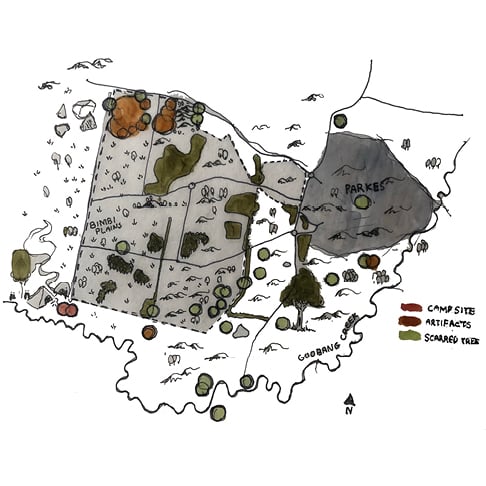
Image source: Michael Hromek, Technical Executive – Indigenous (Architecture), Design and Knowledge, WSP
SAP flood and water quality management
With the effects of climate change likely to prolong drought periods and intensify flooding events, Parkes is an at-risk region.
Engaged to conduct a flood and water quality management study for the SAP, our team developed a set of models to assist in the development of the master plan. To deliver future-ready solutions, our team aims to optimise usage, spatial and master planning, to maximise land value and to minimise project costs.
In these models, we were able to define the baseline environment and constraints on future development.